


Content & User Experience Driving the Set Top Box
September 2, 2010, San Jose CA – At the 2010 Set Top Box (STB) Conference the discussion was focused on the connected home and the associated connected TV. Digital service to the home is the baseline for the STB market. Initially, the STB handled just video service of cable/satellite channels and broadcast channels. Today’s box has to support the video service plus data traffic, telco and VOD services. These other services have been added into the available bandwidth due to the declining bitrate requirements of SD broadcast as sent with MPEG2 and MPEG4 compression.
The availability of bandwidth and internet connectivity has brought on the OTT (over the top) services which is primarily content that is separated from the network broadcast. This OTT content is time neutral (available on multiple platforms on-demand) for schedule, and is also not fixed bandwidth (varying sizes, length, resolutions, compression format), unlike SD or HD broadcast. The OTT content also tends not to be recorded or archived at the home user side. However, this OTT content is increasingly be addressed for display on the large screen TVs which brings it into competition with the regular broadcast for display time.
service provider content
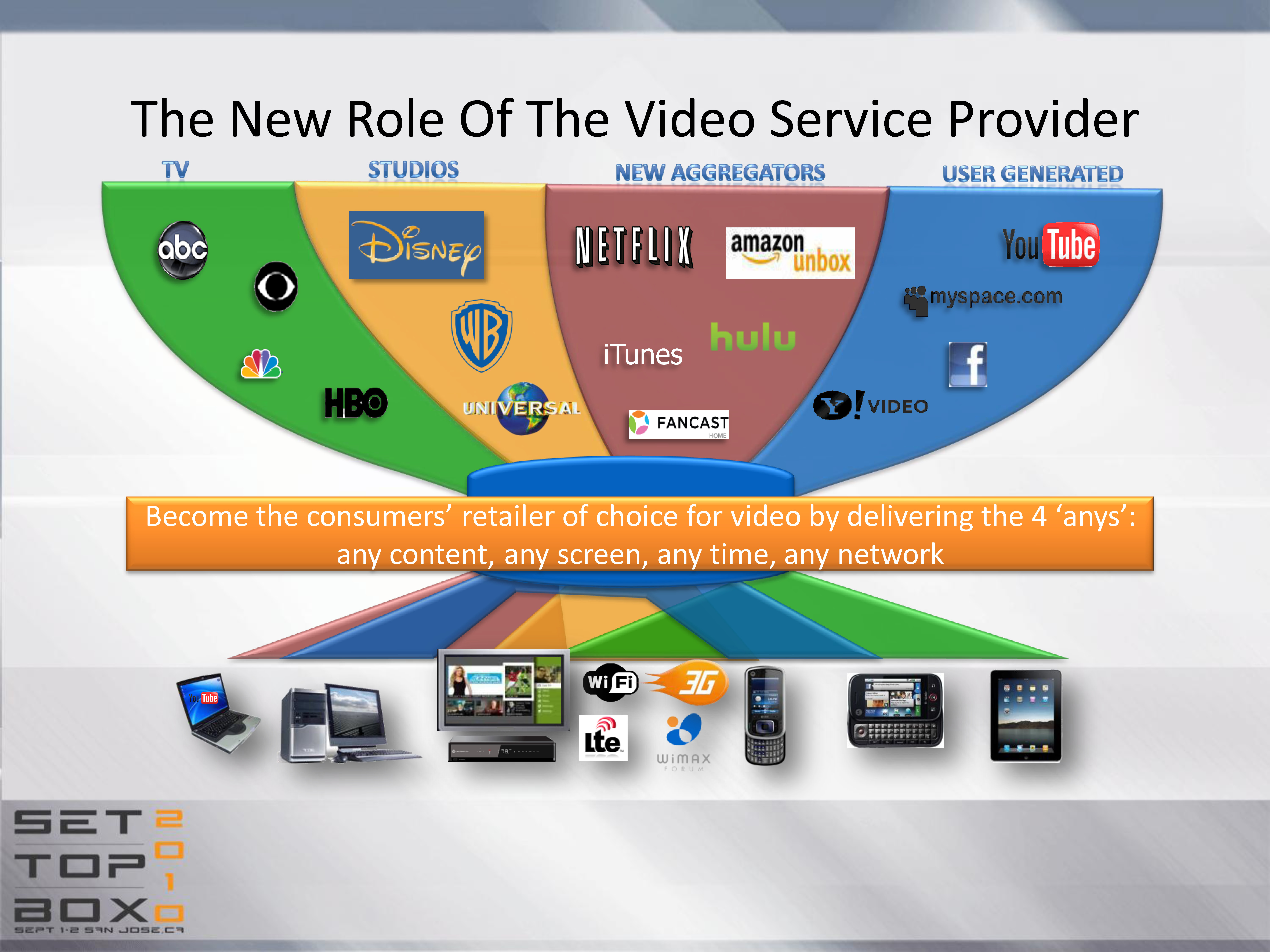
The question discussed was if the OTT and other services, such as connected apps, were causing customer to “cut the cord” to the living room. The consensus from the speakers, (Motorola, Google, Microsoft) was that the main function of the STB was to remain intact. These features and apps were based around the primary content provided by the STB and its service providers (cable & satellite) for the passive viewing experience. While photo/video viewing and social networking was a strong and growing need, they are capabilities to enhance the viewing experience not replace it. The identification of web based video content is hampered by a lack of consistent metadata that would enable complete search. The STB based service providers have searchable content in a user familiar format. Even extended boxes (gaming consoles, BD players, etc) access organized OTT content and private network (e.g. Xbox Live) focus on metadata tagging to both sort and search for content.
The key technical challenge in the STB community is access control. Traditional TV viewing has been with an arrow based and dedicated function button based remote. Web and OTT content, due to their text based search methods, are much more convenient when the access device is a keyboard. For the TV/STB application, the pointing of the remote can be made equivalent in function for a mouse type input. The creation of new remote controls, in the traditional form factor, with improved UIs that will support both visual and text based search are a fundamental step to advanced STB adoption.
Next generation STBs and gaming platforms can readily address the growing 3D needs with simply new cabiling and wireless interfaces as well as minor firmware adjustments. There is no fundamental “overhaul” of the design and data flow needed, it is more of an alternate protocol, than a wholesale change.
personalized TV
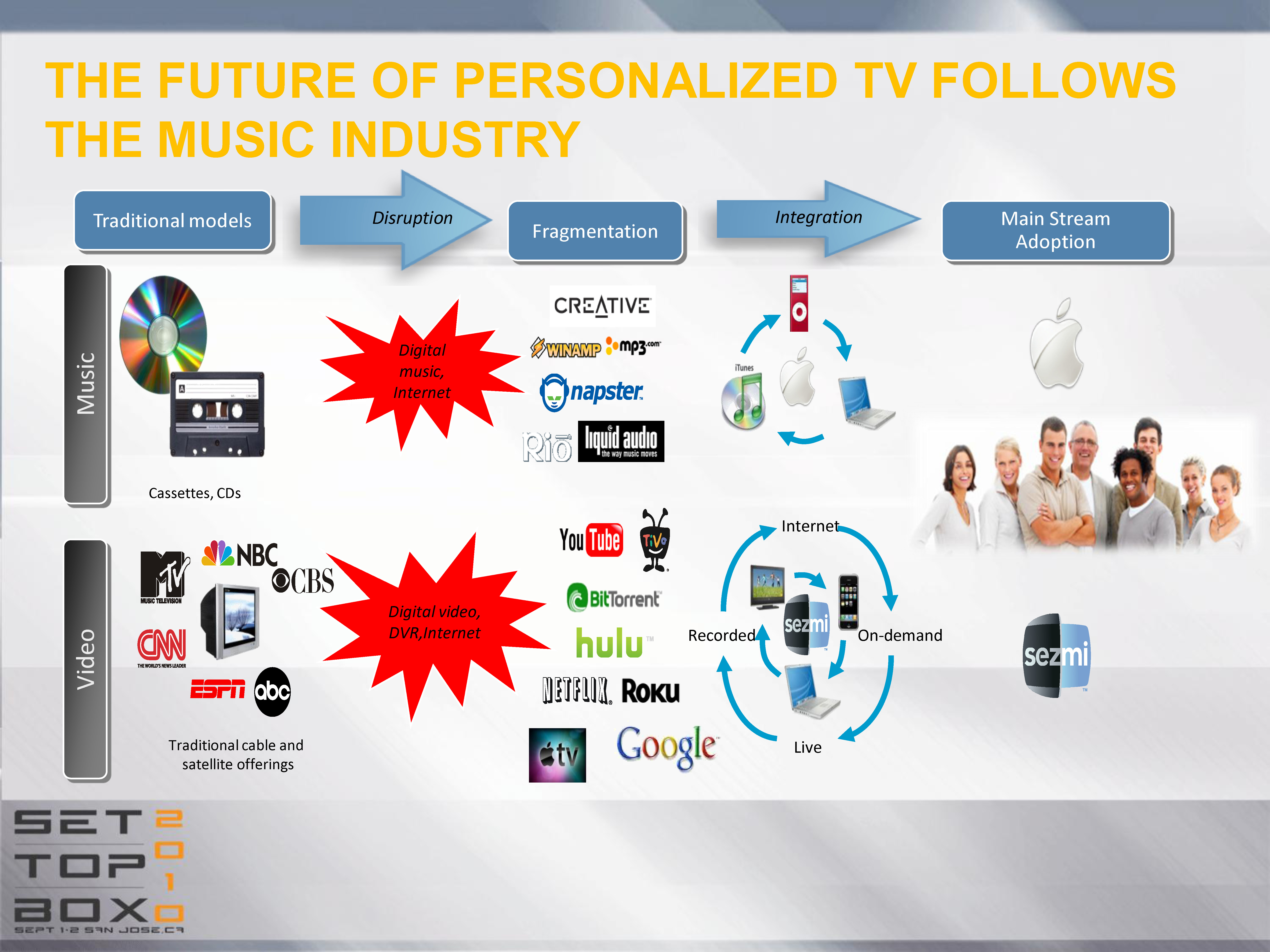
The two big question marks on future growth were in the are of Apps and video conferencing. Due to the large screen size, and not being a close touch screen style interactive environment, smart phone and mobile apps will have to be re-engineered to support connected TVs and boxes. The major difference is the apps will have to support a reduced screen size live view of the video content while the application uses the balance of the screen for its function. In shared memory systems with multi-ciore processors, this is straight forward but dramatically different from a single tasked low resource availability phone. Video conferencing has always been a goal for the living tool since it was so prominently displayed as a centerpiece of the Jetson’s household in the 1960’s. The bandwidth connected to the products are now sufficient for two way calling, however latency and syncing the slightly compressed audio for multiple callers with the heavily compressed video is a major issue that has yet to be solved with in-TV compute resources.
PC
