


Hyper-integration platform in 2045 – ISQED 2011
March 15, 2011, ISQED, Santa Clara, CA—Kamran Eshraghian, president of Innovation Labs in Perth, Australia and distinguished professor at World Class University in Korea talked about ” Multi-technology hyper-integration platform: the technology crystal ball” in his keynote address. Looking backwards and forwards allows us to imagine a future electronics industry.
The world of electronics is changing its perspective and now is looking at the potential to construct compute capabilities that approach that of the human mind. Back in the mid ’80’s the emphasis was on connectivity and CPUs had MHz clocks and a small number of transistors. As points of comparison, a mouse has about 21 million neurons and the mouse brain consumes about 7 W of power and weighs about 2 gm. A human has over 100 billion neurons and consumes 20 W. Current projections anticipate by 2020 that a PC will approach brain speed in overall throughput.
In the past, electronics have moved systems into silicon. In 1883, JJ Thompson discovered the electron. In 1959, Jack Kilby invented the IC which reduces the cost of a function by a factor of over one million. In1983, the industry started to use CMOS, and in 2008, HP announced a working memristor, which mimics ambient intelligence.
In a parallel track, neuromorphics got introduced by Carver Mead at Cal Tech to show how electronics can emulate biological functions. In ’89, researchers emulated insect vision, leading to the concept of brain-scale chips. Continuing to reduce process dimensions, leads to the ability to emulate systems. Connecting the dots, memristors are highly suited to neuromorphic applications.
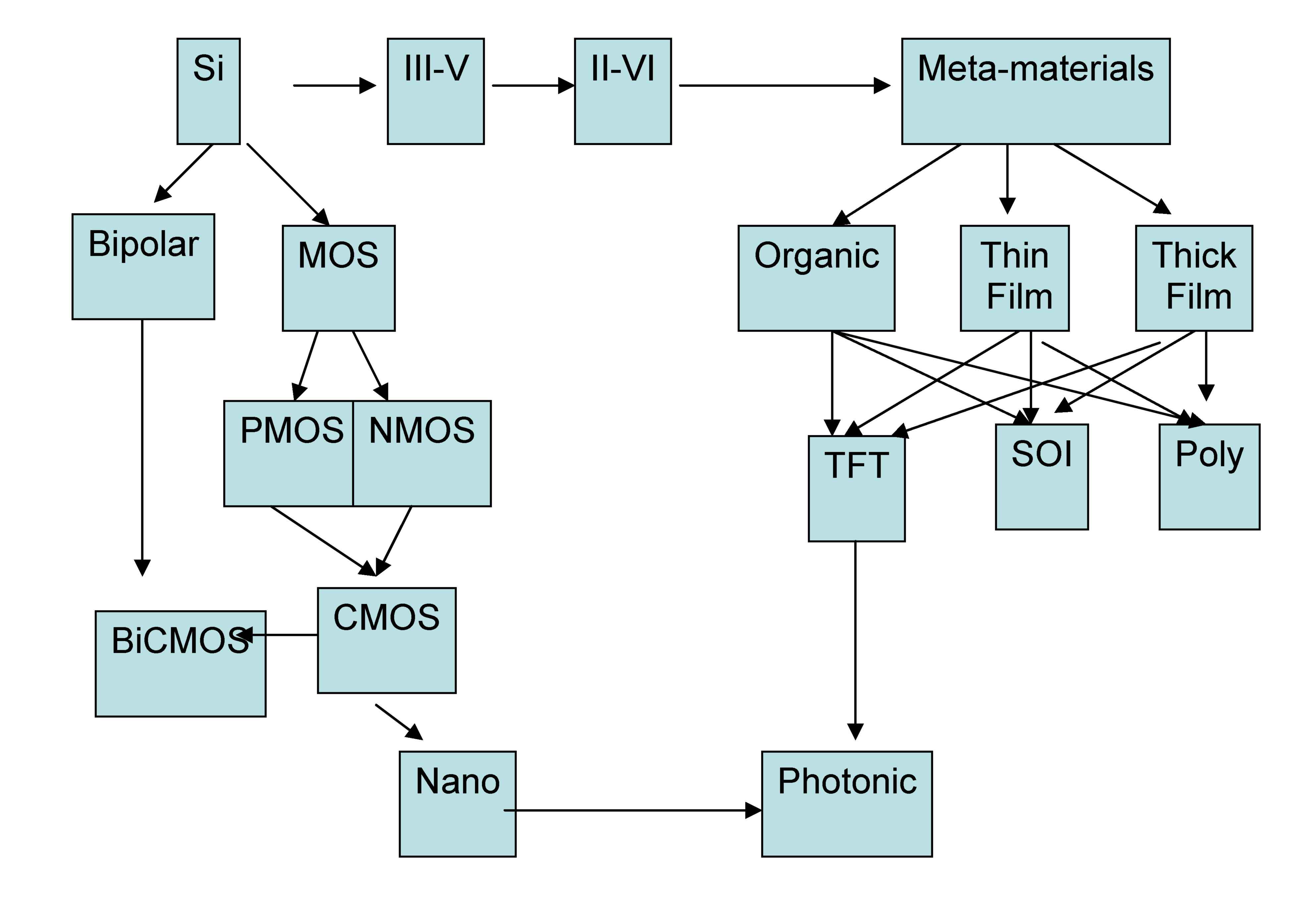
Looking forward, the industry is moving towards 3-D hyper-integration. To achieve insect-size functionality and capabilities will require active substrates and new directions in materials. (see figure) This technology base will have to interface to the world, so it needs a different model for electronics systems and architectures.
The design space will have to look at many interacting parameters. Architecture will have to mix and match from Von Neumann, multi-core, reconfigurable, or even quantum structures. Devices will range from very scaled CMOS, to molecular, to specific quantum structures and devices. These components will be assembled on various materials with complex metallurgy and may even be based on materials other than Si. The state variable for this level of design will be charge and not logical 1’s and 0’s.
The technology base will allow the integration of logic and memristors for mixed-mode analog/digital VLSI systems that implement models of neural systems (for perception, motor control, or sensory processing) as well as software algorithms. Neuromorphic engineering is needed to design artificial neural systems, such as vision systems, head-eye systems, auditory processors, and autonomous robots, whose physical architecture and design principles are based on those of biological nervous systems.
In biological systems, evolution drives species to optimize functions within an environment. Similarly, electronics will change over time to reflect technology changes. By adding ambient intelligence to a phone, you get a meta-phone, a device that does more than just handle voice calls. “Smart cards” could hold your entire medical history and can be integrated with various sensors to actively monitor your state of well-being. An imirror could not only reflect your image, but could use other optical software to change your image to show how you would look in other clothes.
Future networks will have to change the use of spectrum for both wired and wireless connections. Future materials may have negative indices of refraction, “the invisibility cloak function”, to allow viewing of objects through other solid objects. Designers will create new devices based on sub-wavelength nano-particles and the fundamental nature of the basic components will be forever changed..
