


Kionix Intertial Sensors – ESC 2011
May 3, 2011 – San Jose, CA – Kionix, the 3rd largest company in the MEMS and Sensor industry, was visiting the Embedded Systems Conference in San Jose in April. The ESC show was focusing on mobile and embedded computing and display, and Kionix was meeting with both design customers and supply chain partners regarding thier sensor interfaces for these products.
The use of inertial sensors has moved from an advanced feature on handsets and gaming controls to a standard feature that guides most of the UI. Kionix not only designs and manufactures the MEMS and Sensor devices at their Ithica NY facility, in partnership with Rohm Corporation of Japan which acquired the company in 2009, but it creates the application space for the devices. Algorithm and function development are a big aspect of the sensors. The devices themselves, do not drive a UI, it is the application software that allows the interpretation of the measurements in the sensor that is the added specialty from Kionix, and which creates end product differentiation.
Kionix KGY13 Gyroscope
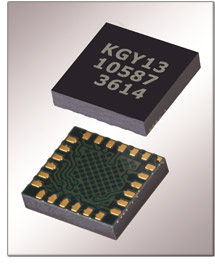
Their dominant marketplace is the tablet/handset & gaming industry. The company has significant design wins in products such as the Motorola Xoom, the Microsoft Kinect and the Droid platform. For these applications, they have been developing “free space” gesturing, which is based on positional movement of the devices, in addition to traditional gesturing UI. This allows rolls, tilts, flips and rotations to actually act as mode controls rather than just cursor control. They are developing a new form of development language for device UI communication that they are calling “gesting” which is a combination of gesture and texting. One of the first “gesting” products is the new watch from Fossil that changes display mode based on arm & wrist movements.
In addition to thse growing markets, they are addressing the “internet of things” marketplace by creating MEMS and Sensors for the Health/Sports/Fitness marketplace. This market is creating a very large number of new portable wireless monitoring products for the home healthcare industry and they are all based on sensor data collection. These products are characterized by increased reliability with improved error correction and a lower power format than is required by the computing devices (handsets and tablets).
PC
