


Mobile Devices for Content Consumption
April 20, 2011 – San Jose, CA – At the Linley Group Mobile Processor Conference, the discussion was on the directions and types of processors being created for the mobile space. The mobile space has greatly changed from the time of voice communication era for basic cell phones with Laptops as the dominant mobile technologies. Today, thanks to the expansion of cloud based services, the mobile marketplace is dominated by smart phones and tablet devices which are primarily consumers of content.
The conference covered a range of topics including embedded security, application processing, wireless connectivity, and media. The mutlimedia portion was further divided into image processing, 3D graphics, directions for voice & audio, and finally the directions in mobile system designs. The challenge is the blurring of the lines between these applications, and creating a hardware configuration that is both performance optimized for the low power environment of mobile and extensible for future for new applications and increasingly large content.
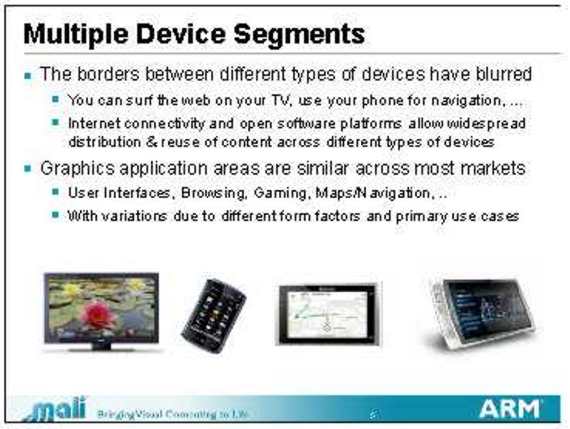
Courtesy of ARM
Where the mobile devices were initially based on lower performance general purpose processors, the new devices need architectural and application optimization. Most new systems have the following components – a general purpose processor core, an audio processor, a security engine for data interchange, a display & touch interface and a graphics processor. The graphics processor now have to support both increasing resolution (VGA to WXGA and SD to 1080p) and increased frame rate, up to 60hz for 3D.
These new cores are from a number of suppliers including ARM, Freescale, Imagination Technologies, MIPS, Tensilica, Movidius, Marvell, TI, and Qualcomm. The key technologies behind these blocks is no longer just the hardware architecture, but the software & application development tools that accompany them. The software allows for the same core IP blocks to delivery aspects of optimization based on if the use model is a smart phone, a tablet device or some other derivative mobile devices (e-reader, etc).
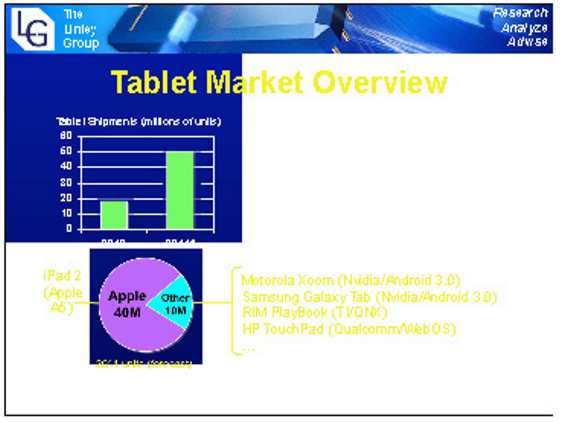
Tablet Overview – Courtesy of The Linley Group
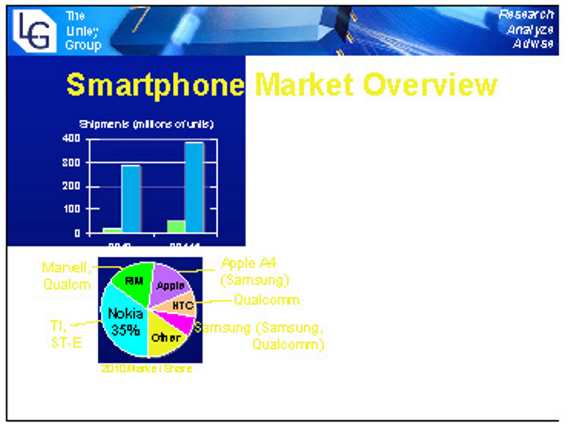
Smartphone Overview – Courtesy of The Linley Group
The mobile marketplace is the dominant driver for data consumption in the near future and the ecosystem is one which is allowing multiple component players to all seek large market shares in a variety of niche areas. The direction in graphics and media processing toward higher resolution standard display formats as have existed in non-mobile devices. will soon simplify the major issue of content creation for this space which is having to support multiple transcoded versions of the same content, and delivering a range of experiences rather than a single unifed QOE.
PC
