


Solid state lamps and lasers – SID 2011
May 17, 2011, SID, Los Angeles—Shuji Nakamura, professor at UCSB described his efforts to realize high-output white solid state lamps and lasers. His is a historical perspective and the current status is for bright prospects.
Nakamura spent most of his professional career working on LEDs and laser diodes. Italy’s been pursuing emitters in like bands that no one else could achieve at the time. In 1971 he created the first n-type materials but could not make a p-type material, something necessary to make a diode. In ’89, he used a modified, dual-stream MOCVD (Metal Oxide Chemical Vapor Deposition) reactor to create p- and n- type GaN materials.
At this time, everyone else was working on ZnSe to get blue diodes. He decided to work on GaN because there were fewer than 10 researchers working in this area, so he had many opportunities to write papers. The reason everyone else was focusing on the zinc compound is because these compounds have a defect density of fewer than 103/cm2 compared to over 109 for gallium. To make matters worse, the GaN materials had a short lifetime, hundreds of hours.
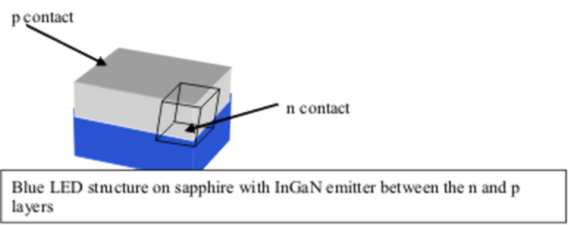
In ’92, he realized a InGaN single crystal emitting layer. He also developed hydrogen passivation for the p-type materials. He now had a blue LED emitter. In ’93, he produced his first high-efficiency blue LED, and in ’95, produced high-efficiency blue, green, and violet laser diodes. Finally, with the availability of bright green and blue, the industry could make a mixture of red green and blue LEDs and the resulting light looks white. An alternative is to use the blue light plus some phosphors to produce white light. Now, the combination of these high-efficiency emitters produces 150 lm per watt of white light. (See figure for device structure).
In 2000, he moved to California to teach at UC Santa Barbara and continued research on m-plane lasers. He continues to work with various nitrites because of their high bandgap range. Over time they can develop various colors with very high-efficiency by doing more bandgap engineering.
Some of the foreseeable applications for these bright lights include backlights for cell phones, monitors, and televisions. With colored laser diodes, they can be used for personal pocket projectors. In a different configuration they can be used for outdoor lighting. With a change in emission spectrum, can be used as artificial light for plant growing, or by moving to the UV spectrum for water purification.
Obviously, these are highly applicable for Blu-Ray and other optical storage media. By making larger devices with different thickness layers of the InGaN, the materials could be used as solar cells with high efficiency, wide spectrum absorption characteristics. These high-efficiency materials are outperforming alternative light sources in terms of color spectrum and power efficiency. There are many other applications for the various combinations of emitter colors and absorbers.
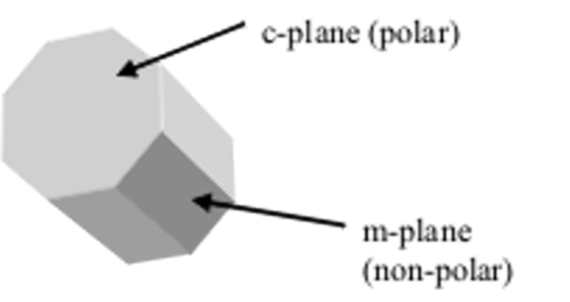
GaN Crystal for Laser Diodes
The GaN crystal structures can be produced in non-polar and semi-polar configurations and the m-plane materials have a flat bandgap compared to a notch on a slope in the c-plane. Unfortunately, materials can only produce small substrates and the greatest challenge is the green efficiency in the semi-polar c-plane. Green laser diodes would make projectors easier to produce because they high-efficiency Green would put out more light than blue, with less costly phosphor. Currently, blue and green laser diodes put out about 4 W of light.
