


Big TV – IEEE CE / ComSoc
October 5, 2013, IEEE Communications Society and Consumer Electronics Society, Santa Clara, CA—Peter Symes from SMPTE, the Society for Motion Picture and Television Engineers, talked about the displays and infrastructure beyond HD. The next generation of TV will have brighter and sharper pictures, but the challenge is for the industry to not have another 3-D experience.
SMPTE works within the motion picture and TV industries to develop standards, provide education, and publications for their technical members. The organization has been around for a while, and is planning its century celebration for 2016.
As the industry gears up to release the UHD-TV sets, it is moving from a 1920 x 1080 pixel screen to higher pixel counts on the display. A 4k TV would offer a 3840 x 2160 image, and an 8k screen doubles those number again to 7680 x 4320. These big pictures will be configured to be viewed at a distance that keeps the eyes from seeing the individual pixels.
The eye can see about 30 cycles per degree. At a viewing distance of three times the picture height, the angle of view is about 19 degrees, so the vertical resolution needs to be 550 cycles or 1100 lines. A 4k display would be viewed at 1.5 times the picture height, and an 8k display about 3/4 the vertical height. This allows for a nominal viewing distance for any of these displays of 8-10 feet.
2k versus 4k screen diagonal size versus viewing distance
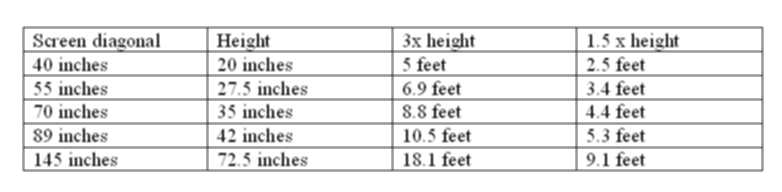
There is no change in viewing resolution at the nominal viewing distance. The differences are indistinguishable for displays under 70 inches. The benefit of the higher resolution is not higher resolution, but closer seating distance and easier fit into the viewing room.
Other changes in the TV might include high frame rates, high dynamic range, and increased color gamut. One challenge is to get all the enhancements to work together. A HFR image on a UHD set could provide much greater visual resolution due to the increased number of pixels and the faster refresh, but some may not want the higher sharpness. The combination can cause strobing except for slow motion. In some tests with the BBC at 300 fps, the images appear to flash at some sub-frame rate. In addition, the capture and display have to have the same frame rates or the problem gets worse.
At the same time, however, the higher resolution causes more motion blur, so the higher frame rates are needed. Many companies and organizations are investigating things like compression efficiency and interfaces for frame rates much greater than 60p. For more information, go to www.red.com/learn/red-101 for a tutorial on temporal aliasing.
The UHD TVs will also need to address high dynamic range. The eye can extract useful information over about 30 stops or a ratio of 1M:1. The effective contrast ratio for normal vision is about 14 stops or 10,000:1. In comparison, a TV has a contrast ratio of 30-100:1. Some of the challenges are related to the inferred viewing space, a dark room. The displays still need to show brighter highlights.
This change to HDR will require a full system redesign. At IBC this year, someone demonstrated a display with 3,000 nits brightness, compared to a standard of 100 nits. The demonstration also worked with existing displays without HDR. The big problem is the enhanced picture has to tell the display how to adjust for best overall response within the full range. One question is where to put this additional intelligence; the receiver, some other external box, etc.
Color gamut is the description of the range of colors that are displayed compared to the natural eye response. The figure shows this chromatic diagram, and the standards response areas are triangles within the curve. HDTV covers less than digital cinema, which is about 60 percent of normal color response. The cinema projectors can represent the colors, but cannot project the colors to match. Increasing the color gamut makes the displayed colors “truer” to nature.
The UHD televisions will improve resolution is spatial, temporal, and color spaces. Other optical issues still remain for anomalies like object blur, bit depth, and color because people can tell if these characteristics are better than the alternatives. Testing shows that spatial resolution improvements are the least important to most viewers.
Compression is required to handle all of the bits in the various flows. In a studio, the data are moving at greater than 1 Gb/second. For broadcast, this is about 15-25 Mb/s. to be able to broadcast the original content requires a compression of 50:1, which is available in MPEG 2 and H.264. Even more compression is needed to go to UHD. Numerous organizations including SMPTE, ISO, IEC, etc. are looking into the issues and tring to coordinate their efforts.
The original compression standards came from the Motion Pictures Engineering Group (MPEG). The -1 version addressed small pictures at 1.5 Mb/s. The -2 version is used in broadcast, DVD, etc. and is most implemented as H.262. The -4 version unfortunately is only about 15 percent better than the H.262. One variant of the -4, MPEG4 part 10, is now called advanced video compression and is used as H.264 For the UHD, the next generation of compression is called H.265
The joint video compression group is now working on changes to AVC. The next generation is always twice as good as the current version, and now a pixel in the studio is represented as about one eighth of a pixel for transmission. One lesson the standards bodies learned is that it is better to define the bit stream and allow the vendors to innovate on the encoders and decoders while maintaining full back compatibility. The traditional method was to define and build a decoder.
The latest HEVC is 40-50 percent better than the best AVC encoders. An HD AVC stream is 6-9 Mb/s and is only 3-4 Mb/s in HEVC. UHD requires 16-24 Mb/s in AVC and only 8-12 Mb/s in HEVC. The important issue is that the HEVC stream fits into a standard broadcast channel.
Now we need the silicon for the decoders and are waiting for the full system design. There are some remaining obstacles in licensing and royalties before the full rollout can occur. At the same time, other non-consumer products can use the technologies to supplement the existing 8-bit video. The enhanced technologies like professional, HDR, and color gamut are not just for consumer goods.
SMPTE is defining the UHD ecosystem as a natural evolution from HD. Increasing the display size is considered good, because it will drive more TV sales. At this year’s CES, 20 companies showed new 4k displays, which will help the manufacturers raise the prices for the premium products.
One big issue is that no UHD content exists. One danger for the industry is that people may watch HD 2k material with up conversion, but he compression levels may not be good enough for the up convert. As a result, people will see many more artifacts if they are too close to the set, and will make the UHD rollout similar to 3-D.
The compression is going through revolving standards in organizations like ITU, SMPTE, etc. for the distribution compression standards including MPEG, DVB, ATSC, and FOBTV. The platform people are looking at HDMI and other interconnect standards to find ways to get the content to the display. These standards are trying to effect the full glass to glass chain, since any failure will bring down the whole system.
In the production areas, the cameras are seeing the live inputs running at up to 24 Gb/s, which requires compression before any further processing. Other issues like master camera formats, mezzanine formats will enter the production flow. The full workflow will need a full range of tools that all address the full range of standards. Unfortunately, HEVC is not ready yet, so the industry needs more tools to create bit-rate savings. The quadrature H.264 needs a synchronization standard.
In the consumer domain, the industry needs to develop clear labeling to avoid confusion and the ability to tell the receiver what optimizations to use. Many companies are involved in developing standards and performing experiments to find the best of the many alternatives. South Korea is experimenting with UHD broadcast, Netflix is working towards a ’15 rollout of 4k, NHK and the BBC did an experimental 8 k feed from the London Olympics with displays in Tokyo.
HDMI is considering 30 FPS at 2160 P for rev 1.4, but UHD needs the HDR at 120 FPS to be good enough. This frame rate is expected to increase to 300 FPS and beyond in the future. So far, 4k cameras are being used in sports for sporting events at high frame rates to enable in-picture slow motion and single camera pan and zoom for HD broadcast.
In addition to work on audio, other work addresses the in-studio interfaces at 6, 12, and 24Gb/s on copper and optical fiber. These interfaces will support 2-D and 3-D production. may are working with the IT industry to get help with the higher bandwidths, but the overriding issues are costs and accuracy. The content counts as much as the infrastructure.
The slides from the presentation can be found on the IEEE SCV Consumer Electronics web site at : http://ewh.ieee.org/r6/scv/ce/meetings/comsec-ces/index.html and the video of the talk can be found at https://www.youtube.com/watch?v=qkWpQi7S_TM
