


IoT and Sensors at IDF 2014
September 2014 – At IDF in San Francisco, the keynote added in the application space and shifting content/use that is being driven by the Internet of Things (IoT) and sensor technologies. These devices are found in the terms wearable, smart home, connected devices and appliances, and mobile device control.
At the keynote, they were showing the wearable from the health and fitness area that was designed with high fashion in mind. In the Expo area, they had an entire pavilion dedicated to IoT and the third parties making products for the IoT space. SparkFun was showing their plug in boards for the Edison and Galileo processor boards. The mini plug-in boards are stackable up to 5 boards high and contain one function each. These functions are units like accelerometers, temperature sensors and humidity sensors.
IDF also featured a development lab where people could show their Edison and Galileo projects as well as build projects. People who built a mini-project in the lab, were given a development system to take with them. Some of the projects in the lab included a banana keyboard, and voice activated controls.
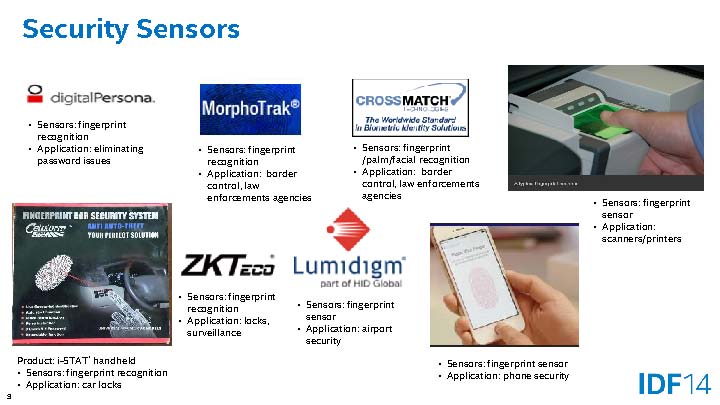
In the sessions Intel had an R&D talk about sensors and sensor research. The sensor session showed the multiple areas for research of devices and products being developed such as the health/fitness area which uses a consumer level biosensor. Other areas included security sensors, which are some of the highest cost sensors in the marketplace, and personal safety sensors. Many of these personal safety sensors are all ready available and use existing technology for data capture and update the information with location based services using GPS.
Sensors for Safety
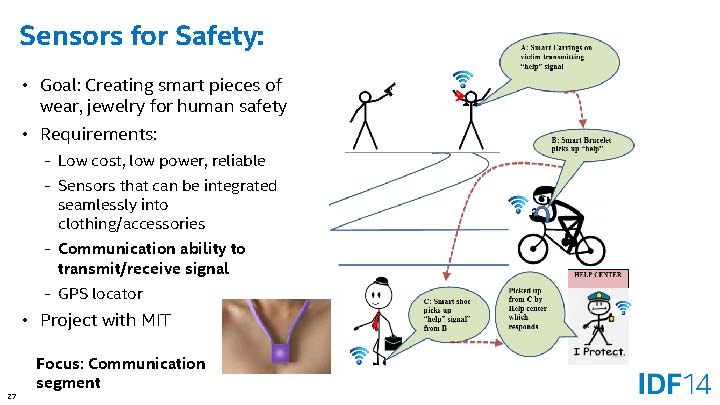
These security sensors cross a large application space, but are primarily focused on determining “identity” of a user and also “location & activity” of the user. These sensors are being targeted to home & family use, businesses, and financial transaction applications. The home & family use includes sensors for pets, home automation and control, entry and exit control, asset control in the home, and personal preference of family members when using shared devices. In the business marketplace, it is primarily access and location control and tracking. On the financial transaction side, it is primarily user authentication applications.
Security Sensors
The main focus on the session was not the sensor technology, but how to use sensor technology to address problems/solutions. The sensors breakdown to the categories of environmental (temperature, pressure, humidity, acceleration), optical (light, IR, motion, photo/image processing), contact (touch and control), and location (GPS, multi-axis movement, altitude, speed). There are existing sensors in all of these markets, the need for new sensors comes for size, power, sensitivity, and durability features for a product that may not be in a current sensor. However the application space, and the combinations of sensor functions is almost limitless. As was noted in the keynote, changing a tablet from using a single camera on one side to multiple cameras can change the system from a 2D to 3D view. This 3D view allows for measurement, depth, selective focus, new object identification in the image, and object tracking. This example illustrates how a software change with existing sensors and combinations of sensors can provide a new solution space. This aggregating known sensors into new groups with new software is going to dominate the sensor based products rather the creation of new sensor technology.
