


Network Gateway as a platform at Uplinq
September 2014 – at the uplink conference in San Francisco, QUALCOMM held a session about the best place for software and applications to reside in a network system. The options are in the cloud, in the end device such as a phone or tablet or laptop, or in the Gateway device inside the building that connects the local network to the cloud and Internet. The cloud has the ability for unlimited capacity and universal access from any location around the world, the endpoint devices have a better user interface our local and are a good place to store immediate response data, the Gateway sits in the middle and provides 24/7 availability with key local access for your programs.
The Gateway device can run applications as it has dual and quad core processors similar to the latest generation of tablet or smart phone. These processors present the same if not more power than desktop platforms available less than a decade ago. As a result they are a local source for running security backup and can be a main source for machine to machine connected applications that are monitoring the local environment. New apps for this Gateway space include being a media manger, data aggregator for medical and fist fitness products, and a visual monitor for information systems and imaging that is available at the location.
The Gateway opportunity is a large volume business. The US which is primarily dominated by wire and cable based broadband and foreign applications in Europe and Asia which are primarily wireless and connect to carriers all need a Gateway product to interface these wide area network connections (WAN) to the local network inside the home or business that may be a combination of wired and wireless connectivity. In 2013 there were 550 million such connections in the United States, and in 2017 it will grow to 725 million.
Qualcomm Gateway Internet controller
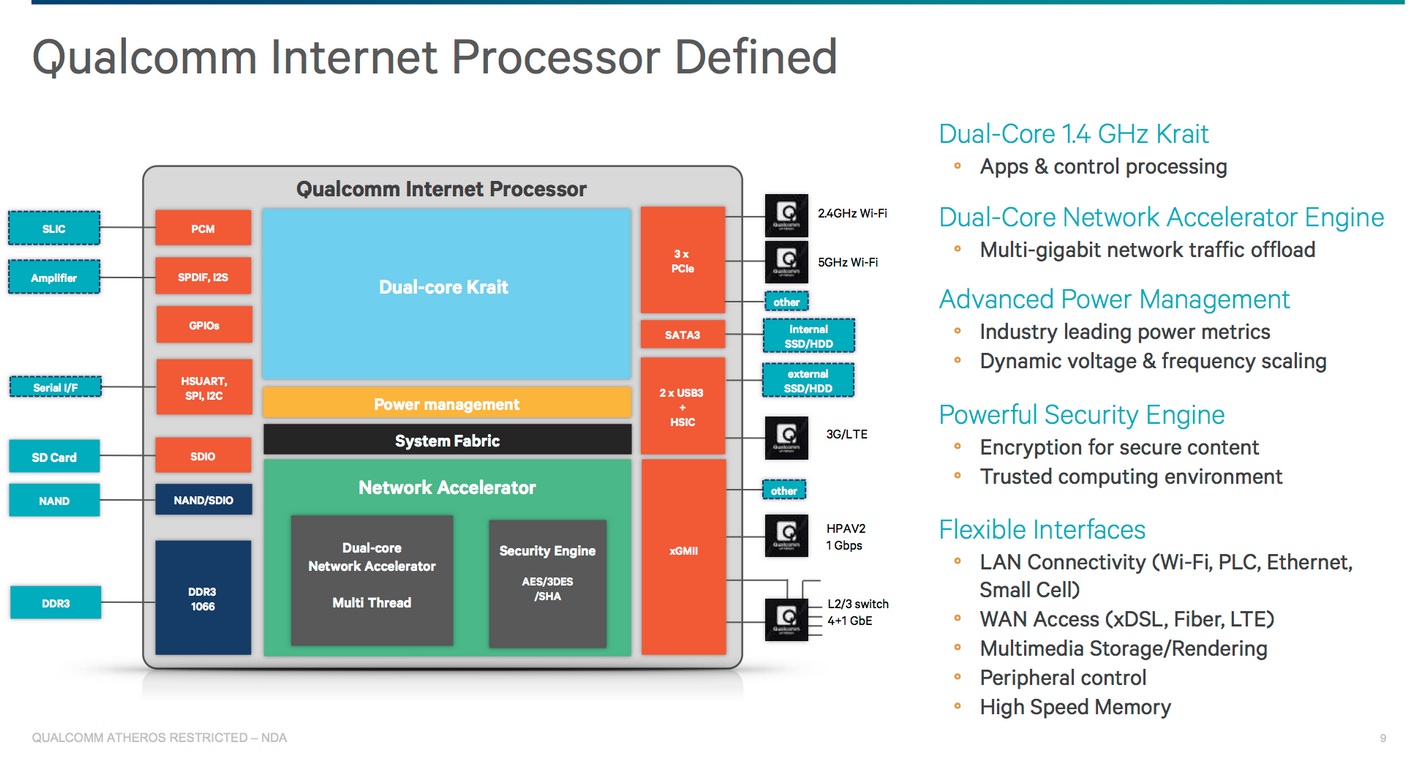
A number of these gateways are starting to use standard operating systems such as android in a replacement for custom created RTOS that are based on Linux technology. The gateways are finding a place in the market that include set-top box STB functionality for content delivery in addition to Internet and broadband access. Being the initial point of entry makes the Gateway the optimum device for security applications and access policies to the Internet. This removes the necessity of putting complex and expensive security systems on every endpoint device.
The modern smart gateways generally serve multiple conductivity standards such as 802 11 ac/n/g/b and support multiple antennas as well as standard protocols such as USB and 802 11 802.15ad. These devices are also supporting peripherals such as Bluetooth and mesh networks such as CIGNA B and Z wave in their configuration. This allows the Gateway to be provisioned for both Soho SO HO and SMB traffic by way of a software defined policy.
