


| | |

Cobra Jumpack restarts your tablet and your car

March 2015 – As mobile devices shift to becoming integral parts of the automotive experience, providing power to those devices is increasingly critical. This shift has even driven automotive designers to adjust the layout and features of the interior to accommodate these devices.  Typically there are two power levels that at needed – a 5v USB connection with 1A output for standard charging of cell phones and a higher power 5v USB connection with 2.1A output that is designed for rapid charge of cell phones and standard charge of higher end smart phones and tablets. 

These increased power drains are a challenge to some older vehicles, and especially those that have a mode where the accessory connector (previously referred to as the cigarette lighter socket) is on and powered when the car is parked.  A large number of people are using the “parked state” of their car as a time to recharge the interior infotainment mobile device (smartphone or tablet) while at work, stopping for a meeting or a short break.  For the media collection side, the new Wi-Fi enabled vehicles are being left “on” to be able to use the network as a hub for the POV cameras as well as the devices being used for playback, editing and posting.  Running all this power with the car off is the equivalent of leaving the lights on when you park.  The result is an increase in the number of cars that won’t start due to a low or dead car battery.


Cobra CPP7500 Jumpack charger
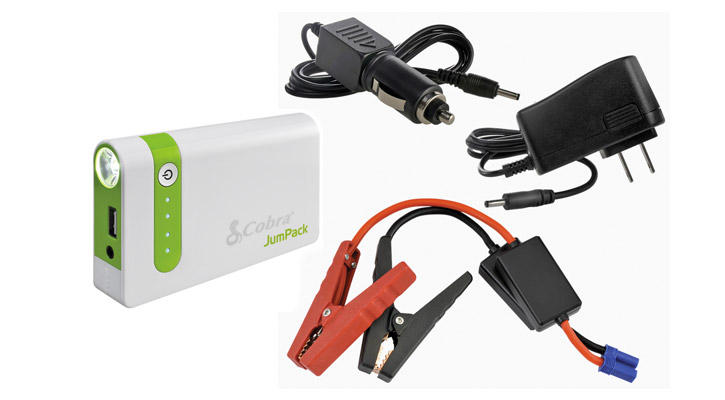
Cobra introduced a market segment leading product to address these two issues – the Cobra CPP7500 JumPack.  Unlike most portable power bricks, these one is designed to do more than charge a cell phone.  The smartphone sized device comes 100% charged in the box, so it is ready to use as soon as it is opened.  The primary function is as a standard 7500mAHr Li-Ion power brick with a high current 2.1A USB output.  This battery can charge several devices, in rapid charge mode sequentially.  We were able to recharge two Samsung Galaxy S5Active phones and a 10” tablet from one powerbrick charge, and drawing the unit down to a 20% power level.

 The Jumpack can be recharged by either an included wall outlet transformer or a car accessory outlet connection, so the unit can be charged while on the way to your destination.  The unit has a series of charge remaining indicator lights so you can tell the progress of the recharge.

 The main differentiating feature is the unit can be used to jumpstart your car.  The compact unit can provide an impressive 400A peak current to a car.  The jumpack has a separate covered connector port that connects with high current capable alligator clips that are designed to connect to the terminals of the car battery.  If the Jumpack is at full charge, it can provide enough power to restart most passenger vehicles and light duty trucks.  Unlike most portable power units for jumping your car that usually connect through the in-cabin auxiliary power connector (lighter), this unit can be recharged after use.

 In the event there is more going on with your veicle than just the battery, the unit also features a high intensity LED light, that can be used as a flashlight, for steady light, a built in SOS flashing pattern and a locator strobe pattern.

 The unit works remarkably well, typically these units that have an impact resistant sealed exterior, have a heat dissipation issue.  The unit, while it gets warm charging the phones and tablets, was still able to be comfortably held your hand, and was not a danger to put away in a seatback pouch when the charging was finished.  The extra cables for the car battery jumping were both easy to use, had a strong enough grip to hold on to both top mount and side mount battery connectors.  The connector to the Jumpack unit is a simple plug in to a socket rather than typical wingnut and barewire connections that sometimes hard to operate in the dark.  As the unit is out in the open air during the engine jump starting process, it cooled down quite quickly after the high current output.  After jumping the engine, there was still enough power to operate the flashlight for several minutes allowing the engine compartment and cables to be buttoned up and put away.

Similar Posts