


Closing in on Rec 2020
June 2, 2015, Society for Information Display Symposium, San Jose, CA—James Hillis from 3M explained how the new standards will be implemented and how manufacturers will be able to measure compliance. The increased color reproduction capabilities will require a retooling of a complex measurement chain.
One challenge is that the ITU recommendations call for a trichromatic system using monochromatic primaries. The main issue is that existing display illumination materials cannot hit the very narrow-band wavelengths required. A practically equivalent approach is a consideration, but practical equivalence depends on the content, the viewer, viewing conditions, and the underlying task.
A study on color discrimination thresholds along the boundary of the Rec 2020 color space helps to establish guidelines for the practical equivalence. As long as a display can present colors whose difference is less than a threshold value, it can be considered compliant. The tests measured discrimination thresholds along the red-green boundary. See figure.
The test setup included a calibrated display and a Windows 7 PC driving a Nidia Quadro K4200 video card. Intensity measurements were with a Photo-Research spectra-radiometer. They measured thresholds in 5 or 6 color directions from the five base colors located on the red-green Rec. 2020 line. Color directions included two along the boundary, one orthogonal, two intermediate to the previous triad, and one towards the white point.
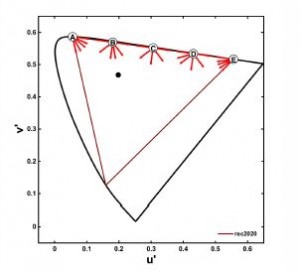
Test points ont he CIE color map
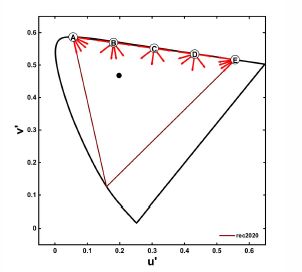
The test methodology used a 2-alternative forced choice task to determine thresholds for the test subjects. Thresholds measurements were in one color direction for most of the test and an additional 2 color directions were used for colors 2 and 4 for a total of 7 staircase samples per color.
The test results were pooled for each base color and test direction and fit with a cumulative Gaussian function. Thresholds were defined as the 75 percent chance of discrimination for each base color and color direction. Data were filled into CIE models and graphed.
The results show that the CIE 2000 ?E color difference formula are valid close to the red-green boundary of the Rec. 202 color space or ?E2000=1 are detected 75 percent of the time. The actual displays need to be within this 1 ?E2000 point to meet the Rec 202 color space. Any colors lost along the boundaries due to imperfections in the primary placement are unlikely to be noticed.
There are two caveats. The first is the assumption of a D65 adapting white point. If an image consisting mostly of yellows, for example, is being carefully visually processed, sensitivity to color differences for yellow will increase. Under these adapting conditions, color differences that would be noticed in a true Rec. 2020 color space may be lost to the observer and/or their appearance will be different when using a display that does not strictly meet the Rec. 2020 standard.
The second important caveat is that there is a good deal of inter-observer variability in sensitivity to color differences. For each base color and color direction tested in our
study, some observers thresholds were inside the ?E2000 =1 threshold and some were outside. There is accumulating evidence [3] and good reason to think that the use of narrow primaries is likely to increase apparent inter-observer variability in color perception. Under these conditions, setting a guideline for the average observer is questionable.
