


JPR at SIGGRAPH 2015 – VR as the core
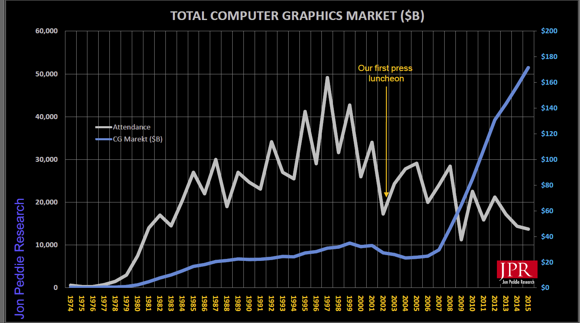
August 2015 – At the annual JPR Press luncheon at SIGGRAPH, Jon Peddie, in his introduction, pointed out that CG market grows exponential. Everything that we count is growing up – said Jon – It is not because we can do more now but because it costs less that used to be. Tools are better, and there is a greater and better appreciation of computer graphics by almost everyone on the planet. JPR’s statistics have been showing the growing demand for real world image capture including depth cameras, lidar and 360 cameras. It is come together with new tools for editorial, world building and lighting: real time digital set editing, AR &VR visualization and real time rendering. Now true re-use of assets as CAD and Content Creation have come together. In place is also better resource management tools for assets tracking, compute management and time management.
Here are the numbers.
JPR – 2015 Graphics Marketplace
Following the analyst portion of the event, there was a panel discussion on VR. The first panelist was James Knight, British born, LA based Virtual Production Manager who specialized in motion capture. VR is natural step for Hollywood because they doing virtual production anyway – said James. In process of creating the content and making movies there are three sections: preproduction, production and postproduction. Naturally the production was the biggest piece of the pie. When the CG came around preproduction started became much larger. That started in 2007. You build digital assets in preproduction and use them in production and postproduction. So you build CG room or CG building once – elaborated James. The backbones of virtual preproduction are: performance capture and motion capture. James’s credentials are managing the motion capture for film including Avatar, I Am Legend, Hulk, and Prince Caspian and various video games including, Scene It, Star Wars: The Old Republic, and Gotham Racing. He mentioned that the performance and motion capture are used in features films and games especially where a piece of content is full of disbelieves. That’s main reason. Performance capture and motion capture are very much real and organic motions, they are fully believed – he continued.
Virtual reality requires stereo images, high dynamic range & high frame rates content and that means massive amount of data needs. These images also have high resolution of HD, 2K, 4K and 8K video. How we can support those things both in data capture/storage and post production?
Grant Anderson, Head of Jaunt Studios presented some of camera systems from Jaunt including first generation camera prototype which has 24 cameras all around. He mentioned that was created to find out what kind of overlap is necessary to create 3D 360 image. “When you have real time engine you can fully move around and explore, you have a lot of possibilities there”– he said – “We want to see the images as real as possible in a cinematic world.” He presented current model of VR camera that has a 16 cameras build, 12 around the sphere plus 3 up, 3 down facing units that are all Go-Pro cameras. The cameras, while small and inexpensive have production use issues. The Go-Pro cameras don’t support high dynamic range, and the color capture is not quiet there. As a result they create a way to use the recorded video data by transforming it through Jaunt’s proprietary computational photography algorithms that use geometric calibration, color adjustment and image processing to create the cinematic image.
One of the areas that VR is seeking expansion and attempts at traction is in VR gaming where immersive environments can be created that have real space in new media types that are being created. The VR technology is allowing the integration of digital actors, motion and performance capture, stop motion and other technologies back to the story process allowing the director and the characters to have new freedom in the story telling. The VFX flow is being aligned with the VR to include the sense of “real” in the imagery from the physical models allowing the “realism” to be part of the story.
Sanjay Das, Chief Operating Officer at Tippett Studio, discussed the new languages on how to shoot VR and describe the scene to the cinematographer and the actors so the “shoot” of the scene can be thought trough. There is a whole language for 2D and single screen cinema capture, but the language for the full cylindrical image that is projected on a dome or a VR headset is still in progress. The camera placement, sound capture, and even the point of view of the editing process still have to be developed and finalized. Advances are being made, but it is a work in progress and changes with different camera types and software.
