


AI at the Churchill Club by Tomasz Kolodziejak
August 2015 – A year ago The Economist called the exodus of startups the “Cambrian explosion”. This term was used to describe what happened 540 million years ago on the planet earth when the life forms began to multiply on explosion rate. Today the same is happening due to affordable computing and tools available, but instead of life forms we see substantial growth in number of startups.
One of the areas that are dynamically growing is Artificial Intelligence. At the Churchill club on th evening of August 28 Jack Clark, Reporter from Bloomberg, led the panel discussion featuring five panelists: Adam Cheyer, co-founder & VP Engineering from Viv, Nigel Duffy, CTO from Sentient Technologies, Kevin Quennesson, Engineering Manager & Staff Engineer from Twitter, Lauri Saft VP of Watson Ecosystem & Partner Program from IBM and Norman Winarsky, Advisor from SRI Ventures.
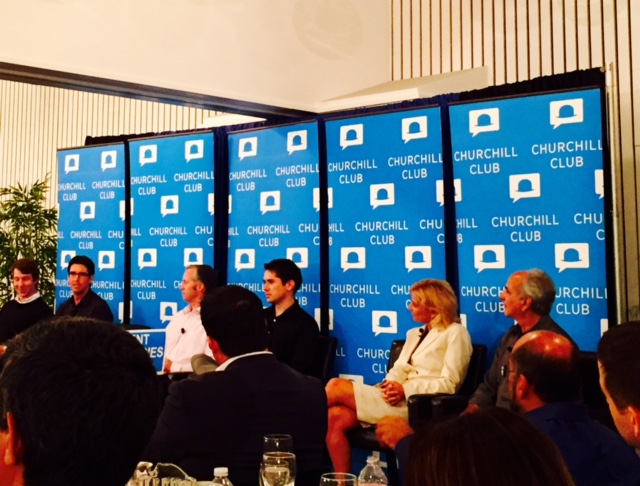
AI Startups: Where are the Opportunities? What entrepreneurs could learn from panelists experiences in that area?
Adam Cheyer sees that in some areas real breakthrough were made including voice and image recognition. He stated that there are many kinds of technologies. Some of the startups are working in specific areas that require a long range vision to realize. Some supply different kinds of technology to create a product like Siri that needs multiple features including speech, language, dialog planning, etc. There is a similar situation with antonymous vehicles. This allows a car to drive using only a deep learning algorithm. This algorithm requires many different features to be present.
Now startups have to think about how to solve the problem using data. The question of the day is “What can I do with the data that is available to me?” This describes the entrepreneur’s dilemma as presented by Nigel Duffy. Startups need to find a problem they want to solve, think about how they can reimagine the problem or solution to that problem.
Lauri Saft approached the subject from a different perspective. She represents a team at the Watson group in IBM that decomposes pieces of technology and distributes them to the entrepreneurs. IBM’s Watson created a platform for startups to engage and play with different technologies. Their philosophy is to take research and put it on a platform. We are also giving the startups a chance for feedback that is needed by the IBM team to improve the platform. In this environment, it is fascinating how quickly the startups are taking off. Within a few weeks they figure it out their directions and problem definition and then quickly get funding.
She said that at the first week of launching the Watson Ecosystem & Partner program they had over 700 applications. She naively thought that there will be more industries coming like: banking, healthcare or insurance, but instead came the companies from different areas as a veterinary company, toy companies and fantasy football. They were the ones that came for little elements of technology to do the magic with.
Norman Winarsky sees convergence of startups that we haven’t seen before with 1,000 or more projects a year. Obviously it is a result of computing, communication and massive data. Many of them are breakthroughs that are making evolutionary improvement in specific area. And there are markets for them. It is all about understanding what market problem we are solving in what space and what technology solution we need. Once you do that, then you can scale and later solve broader problem. If you want to reach Mount Everest you better have a base camp first. The panelists saw many open areas for AI explosion such as: e-commerce or education.
