


Samsung SSI DRAM and NAND at CES 2016
January 2016 – In a briefing at CES, we had a chance to discuss the directions and current state of the DRAM and SSD marketplace from Samsung SSI. The rise in mobile device use and migration to the cloud has pushed the memory and storage requirements of the servers used to connect to these devices. The challenge of the data centers is scalability. The servers have a finite power and space envelope, and they have to increase functionality and compute throughput inside that envelope.
Samsung 128GB TSV RDIMM
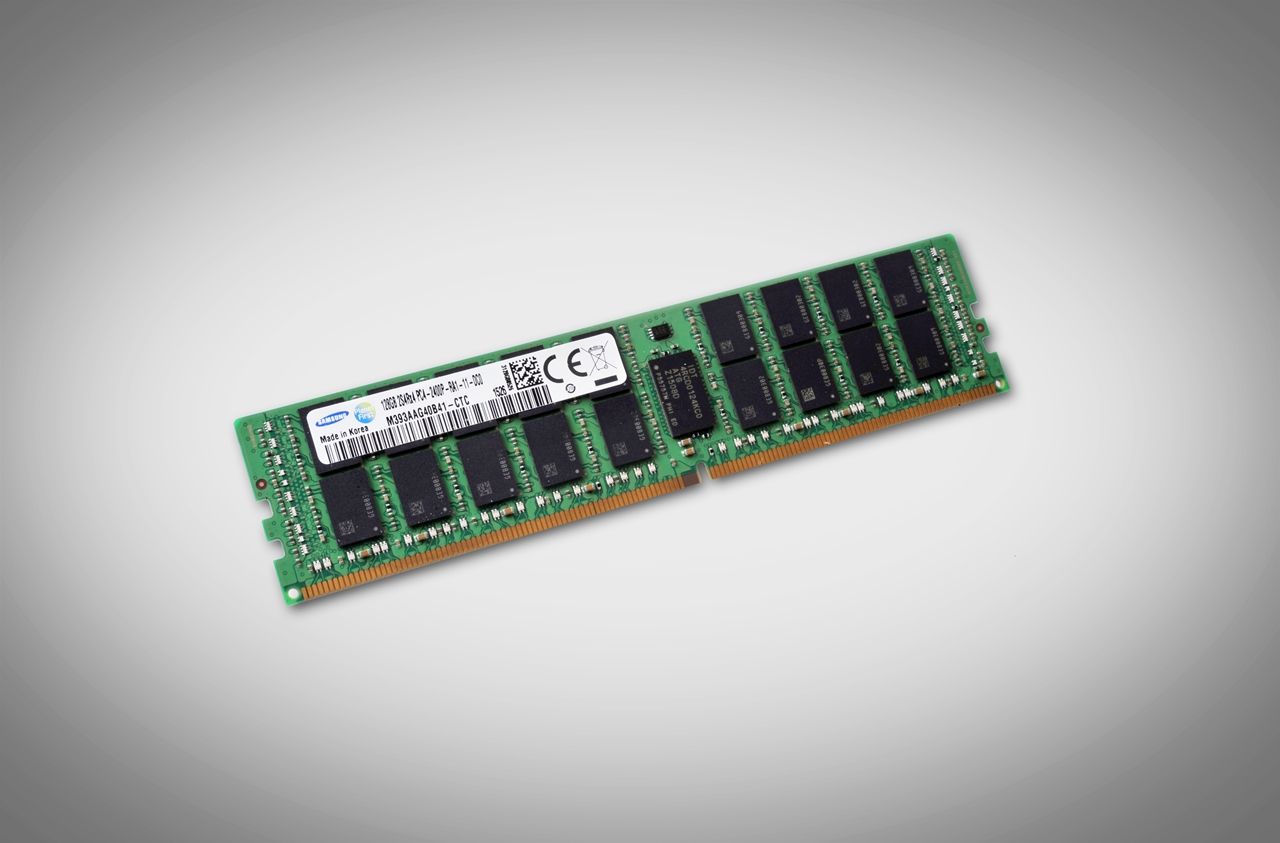
To address this challenge, Samsung has released a new TSV based DDR4 module. The single socket RDIMM and LRDIMM supports 128GB of DRM per module and uses 144 DDR4 chips. The memory provides a performance of 2400Mbps in this density which is both a higher performance and at a lower power footprint than prior memories. The new module is about 50% of the power of the 64GB LRDIMM which are non-TSV based solutions. This allows the enterprise to shift to hyperscale level processing. The current driving applications are those requiring in memory databases for data analytics.
Most of the current generation of single memory database product support 2TB of DRAM, so these modules can support existing 16 slot dual chip server boards (8 slots per chip) which can support up to 32 cores. Next generation modules with TSVs will support data transfer speeds of up to 2,667Mbps and 3,200Mbps to address increasing enterprise server needs. The TSV applications are also going to be expanding into high bandwidth memory (HBM) and consumer product solutions.
The increased throughput and bandwidth on the enterprise side has driven the capability of mobile devices to a higher level. The footprint for storage in ultrabook computers is moving to even thinner and lighter designs. This is pushing the Z axis height of the drives to be constraint. To address this issue, new SSDs with the NVMe interface are being used and being placed directly on the motherboard of the system. These NVMe solutions are rapidly replacing connector based SATA drives.
These new interfaces are producing new cost effective options for the mobile community. Densities are moving from 128GB to 256GB of storage. In real terms, a typical Win 10 installation with office productivity software takes about 60GB of space on a system. This leaves about 68GB free for user data on a 128GB drive. The upgrade to a 256GB unit, actually triples the user space as the OS and installation still takes the same 60GB, leaving 196GB for the user rather than just 68GB. This brings a new upsell opportunity to PC and convertible computer marketplace. From a performance requirement on media playback, SSDs are also moving to NAS applications in the home as an alternative to DAS and internal storage.
