


Nvidia shows of Pascal at SIGGRAPH
July 2016 – Nvidia used the opportunity of the gathering of graphics professionals at SIGGRAPH to announce the newest member of their graphics card lineup. Bob Pette, VP / GM of Quadro products, introduced the Quadro P6000 to the professional graphics product line. The card is targeted at the highest end of the GPU compute marketplace and is the leading edge of their visual computing products. Visual computing is focusing on Visual Effects, Product Design, Architecture, Oil & Gas, and Medical.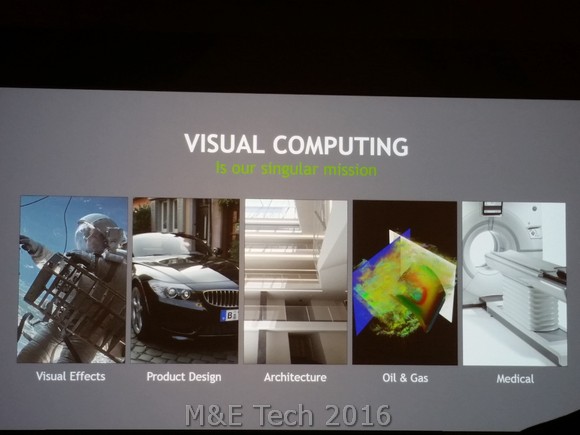
Nvidia Visual Computing Markets at SIGGRAPH 2016
The visual computing capabilities are being driven by 4 main trends – the need to analyze larger data sets, artificial intelligence, virtual reality and photo realism. The larger data sets ae the result of more data to analyze as a result of sensor and monitoring based workflows. These need mathematical analysis which is the origin of GPU compute. On the AI side, the tasks are being driven by the push for generative design. This requires a geomerative library, and the larger the library, the more design options can be compared. This technology leverages Deep Learning to be able to focus on styling in the context of function and performance.
The new P6000 uses a Pascal Architecture for the GPU. The card features 3840 CUDA cores, 24GB GDDR5 memory, produces 12TFlops of performance on a single 250W card. The card supports SLI configurations and can drive 4x 4096×2160 displays at 120Hz. They also introduced the P5000 which features 2560 CUDA cores, 16GB GDDR5 memory and produces 8 TFlops of performance on a single 180W card. Both cards will be available in early Q4 2016.
Announcement was followed by the announcements for updates on a number of Nvidia SDKs. The modules that received updates include Iray, MDL, OptiX, Capture, Video CODEC, GVDB, 360 Video and Nsight VSE. Following the SDKs announcements they had a demo the 360 Video capabilities. A demo that used multiple Blackmagic Design URSA Mini 4K cameras to capture the 360 degree images brought the live stream to the GPU card for realtime processing and stitching for standard video rate output. The VRWorks 360 module was used for the video processing including the real time stitching of the 4K video.
The advanced processing of the new P6000 is being used by Adobe to develop “wet brush” this is a program to simulate oil painting including the texture, depth, color blend, and thickness of the paint and texture of the canvas. The program uses a voxal based simulation to determine and manage the 3D space information of the image.
