


New Rendering Method for High-Resolution LED Displays
February 2016, Electronic Imaging, San Francisco—Dae-Sik Kim from Samsung described a different RGGB color architecture that improves relative resolution and reduces color fringing artifacts. Sub-pixel rendering and new LED color control filter algorithms provide the new functionality.
Large-area LED panels are being widely used in indoor and outdoor displays to provide information in public areas. LEDs are used for their high brightness, but suffer from high costs and low resolution. Various methods have been proposed for improving area fill within a pixel by adding a fourth LED. The efforts included adding an additional rime color LED, a different color to the array, white, etc. to more completely fill the square space of a pixel compared to the triangle that results from a 3-color array.
The problems with previous attempts were annoying artifacts that are most apparent on edges. This color fringe effect occurs in the high-frequency, high contrast edges because the boundary pixels can only emit one color. In low frequency areas, the surrounding pixels can compensate and smooth the transitions.
In addition to changing the pixel structure, the changes also require new light control filter algorithms that understand the characteristics of the LED displays. These characteristics include a sharp emission spectrum and the low fill factor of the sub-pixel area. The algorithm uses 4 types of 7×7 2-D matrix filters with varying parameters. The filters depend on the G or R/B pixel colors and the direction of the edge, either positive or negative. A general 3×3 high-pass filter detect the edges and sets maximum values.
It turns out that the new algorithm improves the peak signal to noise ratio PSNR compared to the conventional direct sub-pixel rendering. Image 1-5 are of various buildings and a dirt bike starting line. The chrominance signals U and V were calculated for the images. See table.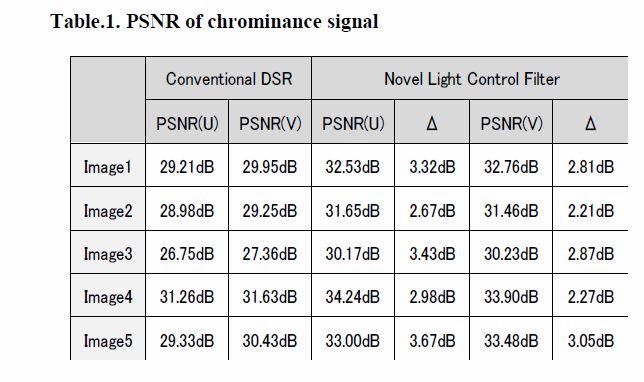
Also, the filter noticeably reduced color fringing as shown in the figure. 
The new arrays and algorithms do not correspond to the VESA resolution measurement from contrast modulation using black and white lines. Instead, modulation transfer function (MTF), which is the amplitude response for a sine wave, provides a better match to the actual display. The problem is that analog signals have amplitude and phase components, so an averaging scheme that accounts for all phase angles from 0- 360 degrees has to be calculated to get a phase-averaged MTF. The amplitude function uses a weighted average of amplitude distributions in a standard video image.
The results show that the RGGB pixel array with sub-pixel rendering can achieve 0.72 cycle/pixel space frequency at a reference MTF of 0.6366. This result is 1.4 times the maximum frequency for a standard RBG structure in both vertical and horizontal dimensions. As a result, the total resolution is 2.1 times higher than the conventional LED array. The calculations correlated with viewing results with a small sample of viewers.
The calculations and test results show higher resolution and reduced color fringing for the RGGB pixel array with filtered sub-pixel rendering compared with the standard RGB display with the same pixel pitch. Reducing the number of pixels to achieve standard RGB resolution results in a cost reduction of 30 percent due to the reduced number of LEDs required for the display.
