


IBM Watson at GTC 2016
April 2016 – At the Nvidia GTC event in San Jose, IBM held a tutorial on the use of Watson in the cloud and the SDK and application areas that are best targeted to the platform. To support the community, IBM has introduced the developer cloud (https://www.ibm.com/smarterplanet/us/en/ibmwatson/developercloud/) which is bringing cognitive computing to developer apps that can use the APIs found in the Watson system.
The cloud has 28 APIs in 4 categories – Language, Speech, Vision, and Data Analytics. These form the keys of the cognitive system. The APIs also include experimental modules and Beta modules for feedback from the community before the features are included into the kits to insure they provide a useful function, and not just clutter the community space. The APIs are supported by sample code that can be found at GitHub that includes code blocks written with SDKs for Python, Unity, Java, IOS, and Node.
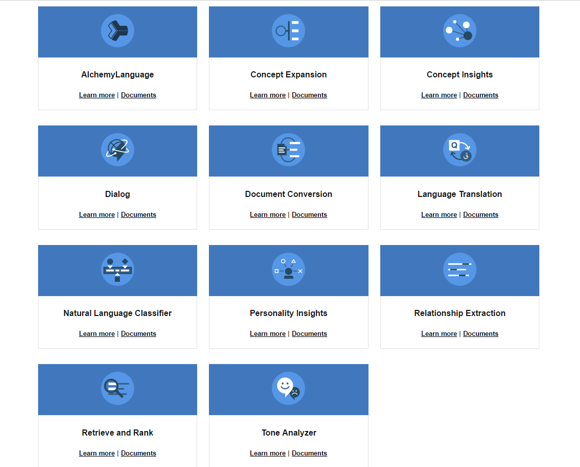
The Language module has tools for the Alcamy Language processing block that can perform Entity Extraction, Sentiment Analysis, Emotion Analysis (Beta), Keyword Extraction, Concept Tagging, Relation Extraction, Taxonomy Classification, Author Extraction, Language Detection, Text Extraction, Microformats Parsing, Feed Detection, and Linked Data Support. Other blocks in the module include Concept Expansion, Concept Insights, Dialog, Document Conversion, Language Translation, a Language Classifier, Personality Insights, Relationship Extraction, Retrieve and Rank and a Tone Analyzer.
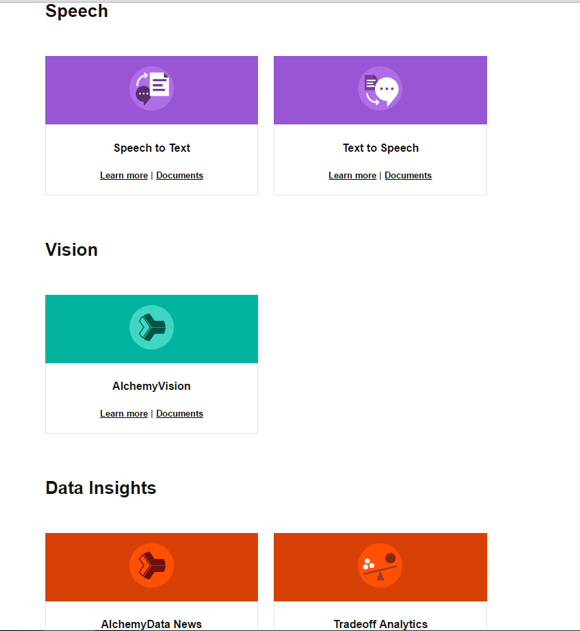
The Speech Module has two blocks Speech to Text and Text to Speech. The Vision module is focused on facial recognition. The Data Insights and Analytics module has the AlchemyData News service which indexes 250k to 300k English language news and blog articles daily along with support for historical search for the prior 60 days. The Data Insights module also includes Tradeoff Analytics. This is a Watson service that helps people make decisions when balancing multiple objectives. The service uses a mathematical filtering technique called “Pareto Optimization,” that enables users to explore tradeoffs when considering multiple criteria for a single decision. Using the service users can avoid lists of endless options and identify the right option by considering multiple objectives simultaneously.
All of these tools are available for developers on a Free Level for initial development and then a fixed price list for each call to the API for the function. This model allows for scaling of expenses linearly with the use of the service.
