


Autodesk updates M&E at NAB
April 2016 – At NAB, Autodesk was showing their continued dominance in the VFX and CG marketplace for video content creation. Their highlight announcement was the acquisition of the SolidAngle product line into their VFX solution space. The Solid Angle product is a mathematically driven renderer that is in the family of Monte Carlo raytracers which is a different solution methodology from the other render solutions already provided by Autodesk. Each of the methods has different “best application” capabilities and optimized compute resource levels, so it does not replace as much as supplement the prior Autodesk offering. A demo reel of some content created with the SolidAngle product was also shown at the conference.
To complete the rendering news, Autodesk made an announcement of the creation of a new custom version of Maya for the Google Zync Render cloud service. The new service allows Maya customers the ability to render 3D scenes created in Autodesk Maya on the Google Cloud Platform ZYNC Render.
Autodesk Maya under the Google Zync Cloud Render Service
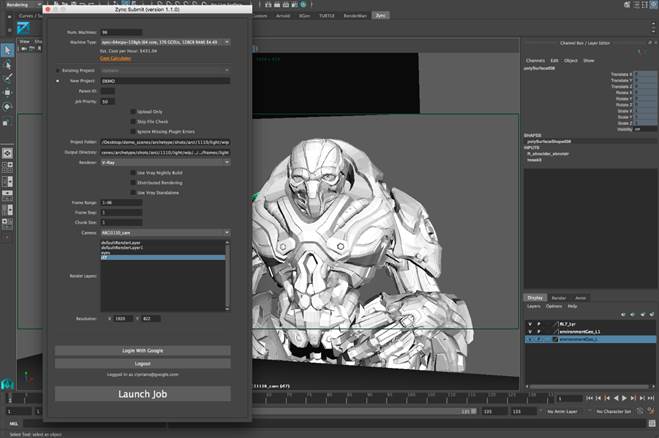
ZYNC Render now has built-in licensing and Maya support as it has had for V-Ray, RenderMan and Arnold. The ZYNC users will now be able to spin up 500 machines per account, scaling to 32,000 rendering cores, with pricing starting at $0.60/hr and utilizes per-minute pricing. This is an exclusive arrangement with Google. The cloud environment allows multiple rendering jobs to start instantaneously, cutting wait time and accelerating production for individuals, and both large & small studios. The Google Cloud Platform version of the Maya render software has been optimized to run as micro-services (cloud instances) at an unprecedented level of computational granularity (cores per minute. The result is that traditional Maya customers could see up to a 10x improvement in efficiency shifting to the cloud. The general Maya render engine also received a new UI for the motion graphics interface and new rigging support & features for the character creation modules.
In addition to the render advances, Flame,a s the anchor of the Autodesk finishing tool received several updates. Now that it is moved to a software subscription model for licenses on a monthly, quarterly and annual basis, the software has been updated to support new camera effects, HDR content and capture through the Lustre integration and supports the new Stingray Game engine.
Autodesk Flame with Stingray Game Engine Integration
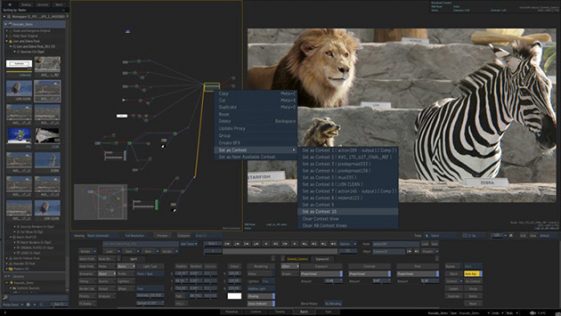
The Camera FX tools come the Stingray engine to enable 3D composites in the action module. The release now supports GPU rendering, and provides features such as ambient occlusion, realistic reflections, and depth of field. The color grading between tools has been improved through the creation of a new workflow from inside Flame. Color grading information is part of a real time interface so composites can be rendered and viewed in Lustre, allowing artists can now move between compositing, VFX, and look development tools. There have also been multiple user requested enhancements included in the new releases that improve the desktop reels, conform, timeline workflow, batch, media panel, and UI.
As a cross between feedback from the standard content world and the gaming creation world, Autodesk made several announcements to support virtual reality and demoed a VR editing workflow in Flame. Audio integration has been incorporated as standard for headsets to Flame to enable artists to work using a headset to see how things are working. As the VR marketplace expands, and camera kits standardize for more uniform stitching and color grading, the tools and workflow will be enhanced.
