


CEO Alex Hui discusses Pericom
November 2012 – In conversation, Alex Hui is sincere, modest, and seems content with the life he has made for himself. He found good people, business opportunities, and created a successful company. Alex is frugal with resources, he never wastes them. He is concerned about resources, including the most important asset – people. He learned what the real problems are, and how to apply solutions to them. Alex created a successful business because he applied engineering skills as compared to marketing people, who identify a market first and then create the business. He identifies resources and creates markets for them.
Pericom CEO Alex Hui
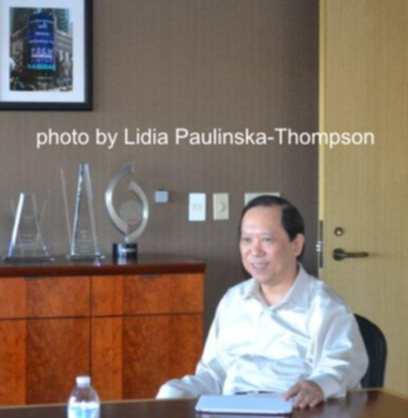
The Pericom Semiconductors Company that was established by Alex Hui and his brother John Hui in 1990 is a worldwide supplier of high performance connectivity, signal conditioning and timing solutions. It has thrived and grown to over 900 employees worldwide with design centers in North America and Asia.
The story began in 1975, when young Alex left Hong Kong to study at MIT as undergraduate, and then followed on with an M.S.E.E from the University of California at Los Angeles. He was not the only family member who sought an education in the US. His older brother John Hui, co-founder of Pericom , went to Cornell University for his bachelor’s degree a few years earlier, and then to UC Berkeley for his masters.
The moment of inception was toward the end of 1989, recalled Alex. He said, “I was a happy engineer, never answering recruiter calls.” In 1982, Alex was employed by LSI Logic Corporation, most recently as Director of Advanced Development. Enthusiastic about his new idea, he started to talk to the VP of R&D to see what opportunities he had. Wilf Corrigan, LSI’s CEO said he would back him all the way, and around April Alex started to recruit people to his new unit. But suddenly in November, Corrigan changed his mind and said let’s pull the plug on this. “That was not fair to the people I talked to,” commented Alex. Alex and John, who was working for Integrated Device Technology as Manager of its Research and Development Department at the time, started brainstorming, and decided to launch the company. Originally it was CMOS memories but “after a year I decided that it is tough to be a fabless memory company and switched to high speed connectivity. The original business plans companies create are often different from the realities that allow the company to succeed.” Alex said and smiled.
“Did you have enough money to cover you and your people while the company ramped up?” I asked. “We did not have to worry about payroll because we raised $2.6 million in the first round, and after one year received another $2.75 million from investors. It was angel investment money,” answered Alex. “Pericom was a success from the beginning and was past break even and profitable in only a couple of years. In 1997 the company went public after already being profitable for 4 years,” he added. This early growth was based on their decisions to partner and co-develop custom processes for their products with a fabrication facility, rather than go with standard processors on commodity fabless model or build their own facility which were the primary options in that time period.
The reality is only 10% of start-ups make it in the valley and the ones with manufacturing costs having the highest mortality rate. The semiconductor industry is also a demanding field. Worldwide there are less than 1500 public companies in the field, over half of which have switched from electronics products for industry and consumers, to producing solar cells. Of these companies in the electronics arena, less than 100 are based or headquartered in the US.
Alex was 34 when he started Pericom. “Everyone was older than I was–– and more experienced. It is important to have excitement and passion for what you do,” recalled Alex. He definitely had passion and it allowed him to recognize the good fortune and opportunities to find the “good people” that brought a “solid and stable foundation” to the company. One of them was a VP at Intel who worked for Andy Grove and helped out and worked with Pericom. “We used consultants to introduce us to good people”, recalled Alex. People matter.
On finding the right people –
Asked for the largest challenges and retaining good employees in Silicon Valley. Alex stated that the industry is more competitive now – domestically and internationally. “People need to be more adaptive and some are more adaptable than others”, he said. As the industry migrated and Pericom made a paradigm shift from just components for PCs to digital media and now more into the embedded space, it is harder for people to adapt to those changes.“Business cycles are getting shorter. It used to be 3 years now is ¾”.
Are people still interested in semiconductor industry? “Young people are less interested in the semiconductor industry. In the Valley you see very few people younger than 45 years old.”
He believes that Pericom has a more stable workforce compared to other companies in Silicon Valley, because the company gives them more time to adapt to changes. “I have been a Christian since college and that helps me see and understand human nature. That reminds me all the time to be aware of reality going on. My faith shifts the way I look at people and myself.” As he sees that dealing with people is still the most challenging in building a successful company, he recognized that “it is not people you manage but also ourselves. I tell my brother we need to set the example and make a conscious effort to establish a high level of professionalism and to be accountable to our customers, shareholders and employees“.
On the future –
His vision for 5 to 10 years into the future is clear. “We are a 50 million dollar company now and I think we can support going to half a billion. There are still opportunities to grow. Adoption is expanding into the networking, telecom, and embedded spaces. From a product technology standpoint, this is our focus on the market as well as geographic expansion.” He mentioned future opportunities in India, Brazil, Eastern Europe and Russia. Earlier in the interview, he pointed out Pericom already has started staffing a few people in India. Revenue from this market is still small but they see a lot of opportunities. “10 years ago, revenue in China was small. It’s big now,” he added.
There is a wonderful, peaceful view onto Silicon Valley from a full- glass window in a conference room on the 2nd floor of Pericom’s headquarters on North 1st Street in San Jose where Alex was conducting the story about his successful creation.
Lidia Paulinska – Thompson
