


Stackable Multi-Touch Panels
At Infocomm, they displayed applications for both TV and display panel like flat screens in the industrial marketplace. Multi-Touch, Ltd of Finland is a maker of “dumb” touch screen displays with embedded speakers. The displays are stackable into a display array These devices are connected to a PC which creates all of the graphics and audio for the display. The PC also interprets the feedback from the touchscreen UI.
The display technology operates as an extended desktop for the PC, so there is very little configuration required to support the panel. The panels do come with a development kit that is primarily to optimize the stacking order of the displays and also applications for the touch screen. The units, since they are driven from a standard PC base, can support up a configuration of up to 14 panels. A PC, with properly designed mother board, can support up to 7 graphics cards. The Nvidia cards support up to 2 displays each for a total of 14. The typical 14 screen configuration is 4 across on top, 4 across in the middle and 6 across on the bottom. Unlike standard displays, these units require space for installation as they utilize 400W of power each to achieve their brightness and the touch screen function. The panels can be configured to the large display by removing thier front panels, which allows them to be stacked in an almost seamless fashion.
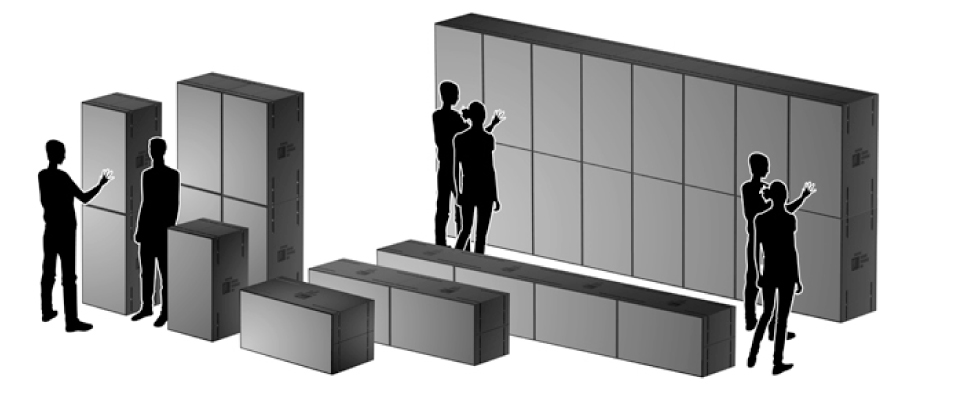
Adding to the list of touch screen technologies (capacitive, resistive, SAW, dispersive), Multi-Touch uses optical methods. There are infrared (IR) cameras on the units which recognize not only multiple touches, but also gestures. These camera system can detect a finger, palm or gestures. The 2D camera system can also be configured to detect specific object shapes on the display. Since it is an optical system, not a contact based system, the panels are made water resistant with a protective glass overlay on the LCD. For outdoor applications, the panels work in most situations, but have a sensitivity to direct sunlight, as it affects the differential sensitivity of the IR pickups. For those applications where they are in the sun, they panels should be shaded with some sort of structure.
The panels are full 1080p displays, and can be driven from Linux, windows 7 or XP and most other operating systems that support spanning displays. The panels have been primarily used for signage and venue applications, but recently they have been targeting the gaming segment. The ability for the panels to be mounted either horizontally, like a table top, or vertically and support multiple gestures rather than just point touch, makes them a strong choice for interactive gaming. As the displays have their own SDK, they are a practical porting altenative to the Microsoft surface capabilities when used for game play.
Currently the large panels support 3D graphics but not stereographic (S3D) graphics. The S3D products are limited to 4″-6″ in size and feature a see-through capabilities. These displays use a film based system so there are no glasses required. There are a number of details on image depth and use functions for the touch screen in the S3D space.
PC
