


Toshiba HDD – New patterning technology for media drives
At the recent Diskcon event, Toshiba researcher Dr. Akira Kikitsu had a chance to discuss the developments in high density HDD medium technology. New patterns and patterning technology are needed to get to the future generation goal og 5Tb/in sq. Dr. Kikitsu presented their results on next generation technology that is achieving 2.5Tb/in sq in data density. These incredibly high data densities are needed to be able to create high capacity (over 10Tb) HDDs in the new 7mm high single platter form factor that being used for netbooks, tablets, and MIDs. Since these platforms are also media players, very large drives are required to support the ability to capture portable video and photo content, as well as play back downloaded media content.
Today’s disk media are made using glass substrates that have a layer of magnetic material made from cobalt-platinum-silicon dioxide. Conventional material is put on as a continuous layer that has bands of magnetic material separated by bands of insulating material. The read head uses a magnetic field to both read and write a magnetic pattern in the material, with the separation between “bits” being an area of noise in the electrical signal. The size of the read head, the spacing between the bits, and the amount of extra material creating the “noise” vs the real storage area, sets the density of drive. In order to increase the density of the media, alternate patterns are being used. The next step towards higher densities is called DTM or Discrete Track Medium. It separates the magnetic layer into columns with space where the noise sources were typically found. The new technology is called Bit Patterned Medium (BPM) and has completely stand alone bits that can be patterned to act for the servo area and also minimally sized bit cells. These bit patterns are less than 10nm in size for the 5TB/in sq data densities. The BPM method uses only magnetic materials with physical separation (air gap) rather than an oxide divider.
In order to cost effectively create these patterns, a low cost & high throughput method of patterning the material is requried. Toshiba developed a method of directed self-assembly (DSA) using block co-polymers to create the small features of the pattern. These self-assembled polymer chains are typically in the 2-5nm size, and form circular pillar structures. The then create a patterning “guide” master, using a standard rotational E-Beam, to draw the larger pattern sizes for the data tracks and the servo tracks. This master is then nano-imprinted, using their in-house developed equip, onto the full platter, and then exposed, and etched using Ar ion milling. This step turns the cylindrical objects into rectilinear patterns.
The following SEM photo shows the results of the processing, where the horizontal and detailed patterns represent data tracks, and the vertical patterns are the servo tracks.
Toshiba DSA BPM
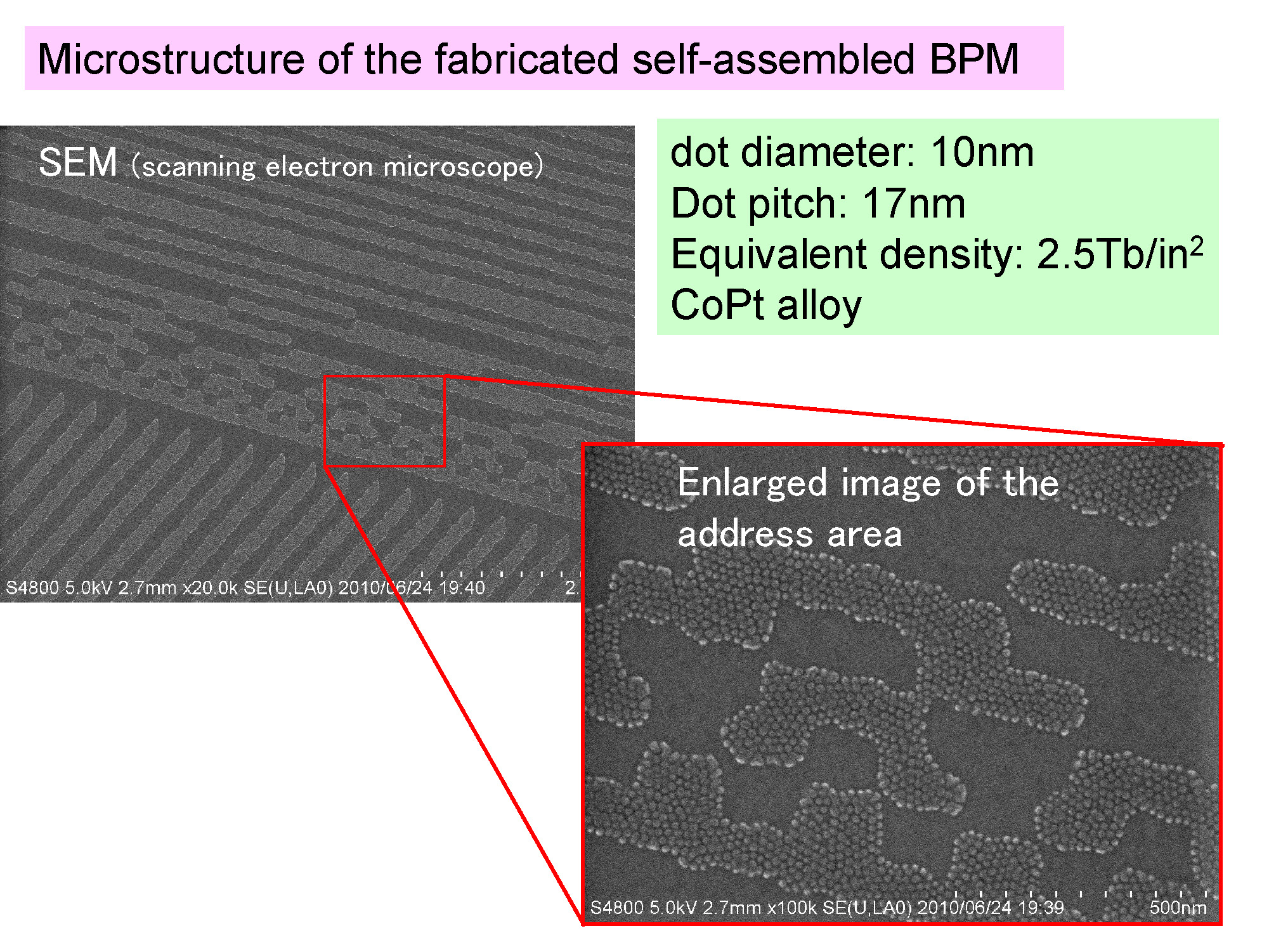
The advantages of the BPM are that only the bit density increases but there is no change to increase the rotational rate of the drives. In some applications, the higher bit densities, which results in a higher data rate through the read channel, can allow for using a lower power, lower rotational speed drive than is currently being used, to achieve the same data rate. The discrete structure of the DSA BPM is also much less sensitive to thermal issues in the media due to uniformity of the DSA structures rather than conventional media where the bit may be made from 6-8 different sized crystal grains.
The BPM drives will need new smaller read heads to bring the products to market. After all of the volume manufacturing issues are finalized. The process is created to support the same throughput as current technologies. The resulting drives using this technology will allow for full media libraries to exist on MIDs, superphones and tablet style products in a battery compatible operating power.
PC
