


M&E Design Moves to Servers
March 2015 – At the Nvidia GTC 2015 event, the power of the current generation GPU compute platforms and the amount of data that can be processed is causing a shift in collaborative workflows. Traditionally, each member of a design and development team had their own standalone workstation with local memory; storage and CPU/GPU compute capability. The design data was usually stored locally and shared via a network.
As the data sizes move to HDR and HFR content as well as increased resolution, the constant movement of the data, duplication of compute and memory resources and multiple application licensing is becoming unmanageable. The workflows are shifting to a centralized server environment with new thin client endpoints that are managed under multiple virtualization options. Examples of this are the Dell Precision Appliance for Wyse leverages the award-winning Dell Precision Rack R7910 workstation, NVIDIA Quadro and GRID GPU technology, Teradici PCoIP remote workstation technology and VMware virtualization software. This single SKU purchase system can be deployed in about five minutes after installation in the rack & powered on. Product is configured to be managed without a dedicated IT staff or by an IT staff with limited virtualization experience.
The appliance can provide access for up to three users in dedicated GPU mode or four to eight users in shared GPU mode per appliance. Users can connect via a diverse set of endpoints including Dell Wyse dual or quad display thin and zero clients, desktops, laptops, or existing tower and mobile workstations.
Nvidia GPU virtualization
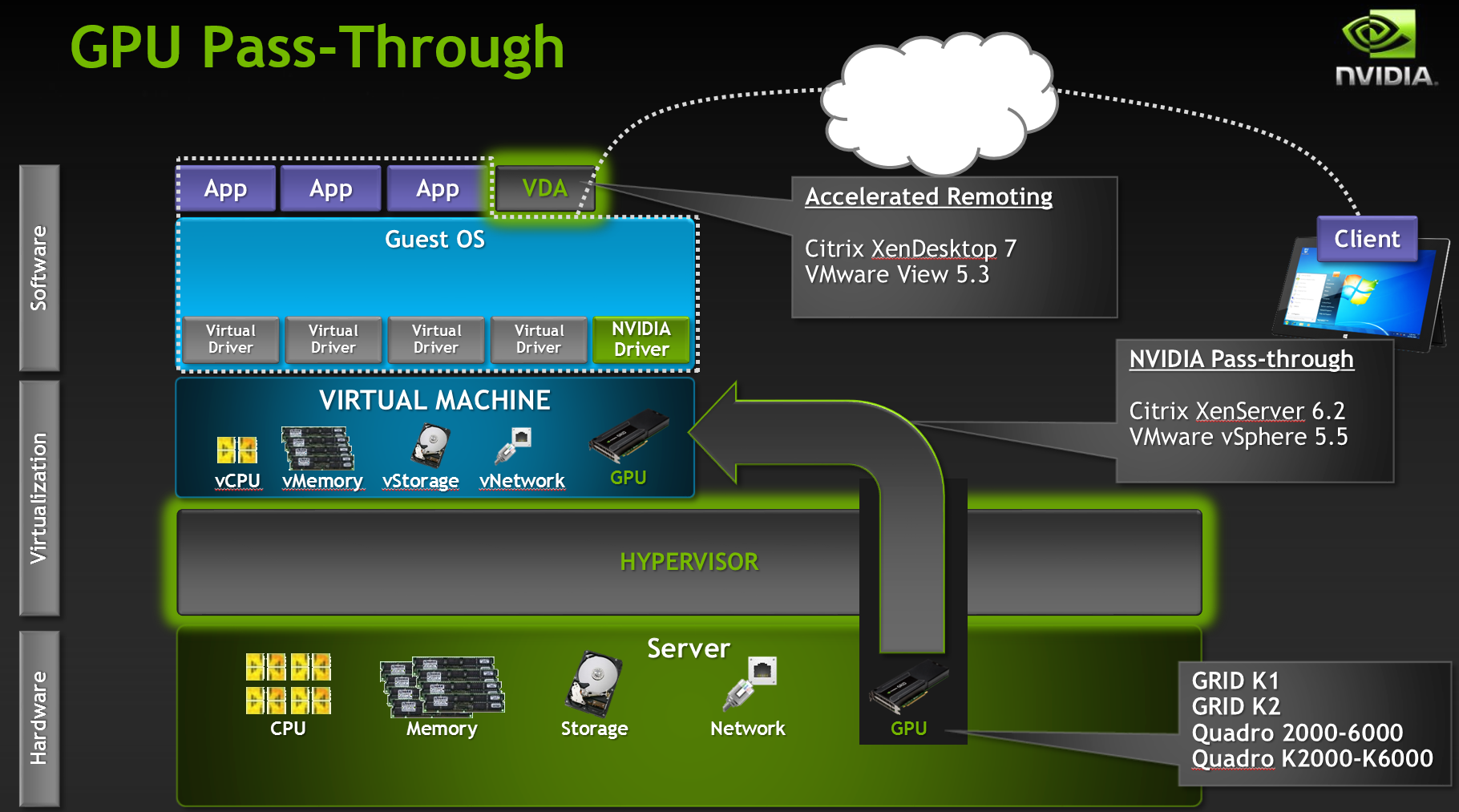
The quad display systems are currently supporting 1080p 8 bit color data at 30fps refresh rates. There are additional virtualization solutions from Citrix that will support a quad display with up to three 1080p screens and one 4K screen. The systems support HDR and HFR on dual display systems. These solutions allow for group collaboration of long run content in high resolution for gaming, TV, advertising and cinema production.
The central appliance connects with standard storage solutions allowing easy integration with existing workflows and networks. The central compute configuration allows for optimization of a tiered storage solution (cache, SSD, rotating media, tape) for a full design team in a central rack setup. The migration to a centralized appliance with thin client, by keeping the data in a single location and access to central compute, delays the migration of the design environment from 1G to 10G at the workstation as well as 10G to 40G at the rack. This delay, will allow the near term option of migration from 10G to 25G at the rack, which allows for more efficient & lower power 100G Data Center to Data Center communication.
