


Films key to new displays at SID 2011
May 17, 2011 – Los Angeles, CA – The annual Display Week event from the Society of Information Display (SID) featured a number of new film technologies for the enchantment of images on electronic displays. All of the films involve materials breakthroughs as well as product innovations. Starting from the small – Nanosys introduced a new Quantum Dot Enhancement Film (QDEF). This film is used in place of the diffuser layer in the traditional LCD film stack. The film contains specially tailored quantum dots which increases the color gamut by 50% while maintaining the brightness of the display from the standard edge lit LED back light. The increased color gamut, selectively increases reds and creats a deeper pallet of greens in the resulting image. The initial application is shown in a standard 40″ LCD reference monitor. The new film has a systematic aging characteristic that can be tracked with the LED backlight aging to give predictability for color levels over the product life. When the film gets applied in standard consumer applications (availa from 3″ to 65″), the resulting color image beign displayed is richer and deeper in saturation over the useful life of the display product.
Nanosys QDEF film use in LCD panel

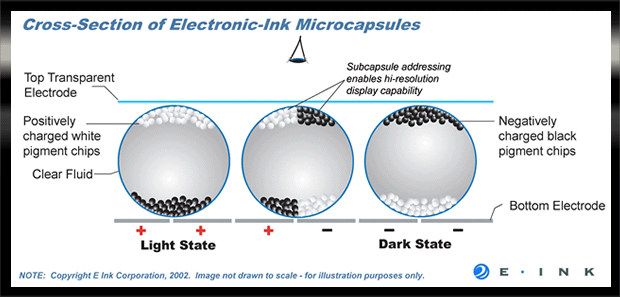
The Eink folks had several new films and technology to show in addition to the new logo for the company. Eink is current leader in B&W epaper displays. The epaper technology only expends energy to transition between images, but does not require any power to display the image once it is rendered. Announcements that made this year included a high resolution, 300dpi, B&W display that can be used in print preview applications on 1:1 basis. Several products that incorporate Eink on flexible substrates which allows for curved industrial design products (such as watches). The major announcement was the introduction of their einkTriton technology color epaper display. This allows for the same low power, reflected light image, with an RBGW color filter. In this mode, the full greyscale capability is enhanced with newspaper like color imagery that gets more vibrant in brighter light. Unlike traditional color printing on paper, the Triton technology does not show any discrete pixilization in the image, and instead produces smooth area color fills. Since the underlying image technology is the electrophoretic display, the power, response time, and resolution are un affected by adding the color film layers.
How eink works
3M, the industry leader in advanced display films, introduced a number of new films and tapes at the show. For display and tablet applications, they have a new uniformity tape that is designed for backlight systems. Current edge lit displays need a fairly close spacing in order to provide an even backlight for display image. The Uniformity tape allows for up to 3X increase in spacing between LEDs and a 3X reduction in the number of LEDs used without the affecting the brightness. The adhesive tape has a micro-replicated optical pattern, so when attached to the light guide facing the LEDs, it eliminates the “head-lighting” effect normally caused by the dark spaces between the LEDs. The tape enables the industrial design with thin bezels and lowered operating energy costs for the displays.
The typical LCD panel uses multiple film layers – Reflector / Light Guide / Diffuser / Prism / Brightness Enhancement Film / LCD. The goal for modern displays is to reduce the thickness of this laminate, the weight, and the cost of assembly. To address these issues, 3M introduced their Vikuiti Enhanced Specular Reflector (ESR) film. Designed to be used as the rear lightguide reflector for high efficiency brightness enhancement in light recycling LCD applications up to 17″ for tablet and other mobile devices. These new films reduce the thickness from 18mil to 10 mil while keeping the same or better image brightness with no color distortion.
Their main introduction was a new product called Collimating Multi-layer Optical Film (CMOF). This product is an integrated film that eliminates the need for all free floating films and lightguides in the LCD design. The CMOF film helps reduce the backlight plastic by over 90% and can result in 7lbs of weight reduction for a 52″ display. In a replacement for the lightguide, a new “air guide” technology for even dispersion of the LED backlight is used, The air guide system allows the LED density to be reduced from one LED every 12mm by 5X up to 60mm of separation, in only 10-17mm of thickness, with the same light uniformity and brightness as the traditional design. The CMOF film can also be used with a high efficiency light guide for the applications (mobile devices) that cannot accommodate the thickness of the air gap. The air gap thickness is sufficiently thin to be applicable for TV and digital signage applications.
All of these products are currently available, and are key drivers toward next generation display products and the industrial designs for those products.
