


Coming, Personal Robots
August 19, 2011, Hot Chips 23, Stanford, CA—Steve Cousins from Willow Garage described the challenges of building personal robots. Personal robots may some day be as personable as Rosie the Robot from the Jetsons cartoon.
Personal robots represent an evolution from industrial machines in the ’60’s. these machines were fixed space robots with limited programmability and functionality. The second generation became more mobile, but task-centered like the Roomba automatic vacuum cleaner. Over the next 50 years, we will see mobile and mostly autonomous robots in the home and workplace. Before this can happen, the robots have to become people aware.
Many second generation robots that got to human scale had functions that were remotely controlled. Willow Garage’s PR1 was such a machine and in ’05, it was operating as a mobile robotics laboratory. Willow improved the arm mechanisms to be gravity counter balanced so they could hold position without power. Since then, their efforts have resulted in an open source robot operating system, ROS, to allow greater robot independence.
Robot PR2
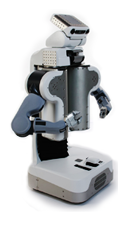
The PR2 was first used as a mail delivery robot. It took pre-sorted mail to each employee’s desk, found the desk and put the mail into the in box. It operates in a live environment with moving people and rearranged furniture without major problems in navigation. Willow made 11 units for R&D groups and they cost about $400k each, a little out of the range for most home users. The ROS allows the designers to reprogram new functions with little time and effort.
One app took about 15 minutes to program; beer me. This program takes an input from anyone in the building, and like an Amazon one click buying, puts a beer order into a delivery queue. The robot has to go to a refrigerator, open the door, and find the proper brand which is put into a delivery tray. Then the robot has to navigate to the ordering person’s desk to deliver the beer. The ROS has some primitives like find, get, deliver but the function is actually fairly complex.
The next technologies will enable remote presence and allow a remote person to be represented by a robot in the physical space. Think about Skype on a walking stick. Meetings and conference calls are already handled by a laptop computer, Skype, and a Logitech camera with control of pan, swivel, and zoom.
This remote presence changes the interactions between the present and avatar-represented people with the hardware becoming invisible to the other people over time. Instead, they feel like they are interacting directly with the person on the other end. Mobile telepresence still needs a lot of work. The UI is rough and the protocols are still emerging.
The next phase will be to act there. These robots will be able to use their sensors and built-in intelligence to act remotely and autonomously manipulate objects. The overall versatility will allow the robot to carry out requests without detailed programming. Before this can happen, the robots need much better sensors and computer systems.
The PR2 has a number of operating modes. Manikin mode allows manual positioning of the arms and body. By adding optical sensors like the Kinect to generate 3-D point clusters, the robot can handle and move objects through a space. Previously, the PR2 only had 2 cameras plus 1 in the forearm for fine detail of objects in the manipulators. Navigation is from vertical and horizontal tilt lasers and a ladar (laser based radar) unit for distance calculations.
What they need is a way to create 3-D point clouds of room size versus the couch distances available from the Kinect sensors. The PR2 only has basic object recognition and minor manipulation capabilities because the robot hands are easily broken. Processing is handled by 2 computers with 8-core i7 processors and 1 TB of RAM. Over 60 percent of the battery goes to power the CPUs. The gripper has 15 sensors with 7 located around the edges.
One major challenge is the sensors and their wiring. The wires have to go through limited space and have to go through various joints. The wires are more mass that the motors have to move. Some of the connections are via slip rings for the joints that rotate adding noise to the sensor signals.
Overall, the PR2 is a good platform for hardware and software development. The modular hardware and software help to reduce hardware and software development times. For example, they spent 1 week modifying the grippers and software to get the PR2 to play pool. This is on a restricted billiards ball set and not a full color pool ball set. The playing software is from a pool game and calculates angles and forces.
Robots are still in early stages of development. Just like the Altos from Xerox PARC was not the final platform back in ’73. The first PCs didn’t do much until the Apple II came out. The PR2 is like the Apple II, it is a small robot development platform.
Ongoing challenges include human-robot interaction, manipulation, and perception. No one knows how people should and could interact and what the best interface should be. It’s definitely not a mouse and screen. Mobility is mostly solved, but manipulation is still in research. They have force control, but still need better force sensing. Perception is really hard. Most functions need extra fixturing and helping with problem reduction. Complex real-time control is very hard. One goal is to get the robot to wipe off a table.
ROS is one example of research results. What they need are better batteries, huge shared memory computers for perception and planning, real-time response, fast communications and access to the cloud for storage and longer-term programs. The current platform uses 9 video cameras, 2 laser scanners, and a ladar unit. Together, these sensors, just for vision and navigation, completely overload a WiFi port. Changing the video from continuous to snapshots helps a little, but is not really the answer.
With all of the video sources, they need GPUs with Ubuntu support. At the same time, they need to find ways to reduce the wiring and connectors to improve reliability and reduce weight. The slip rings for the rotating joints adds mass and electrical noise to the system. They need to find ways to make hobbyist-level machines to enable the tinkering phase of development, because the tinkerers can find more solutions than a company can.
The future generations will need many more specialized processors. Some of the processing has to be integrated into the sensors to reduce compute loads and improve response times. Close range depth sensors will enable fine-grain and delicate processes and putting texturized light sources next to the sensors will improve spacial resolution and accuracy. Most importantly, they need cool chips, ICs that run on a fraction of today’s chips. There are many potential applications for mobile, autonomous robots that can help people in many ways. We are getting there.
