


John Peddy Research at Siggraph
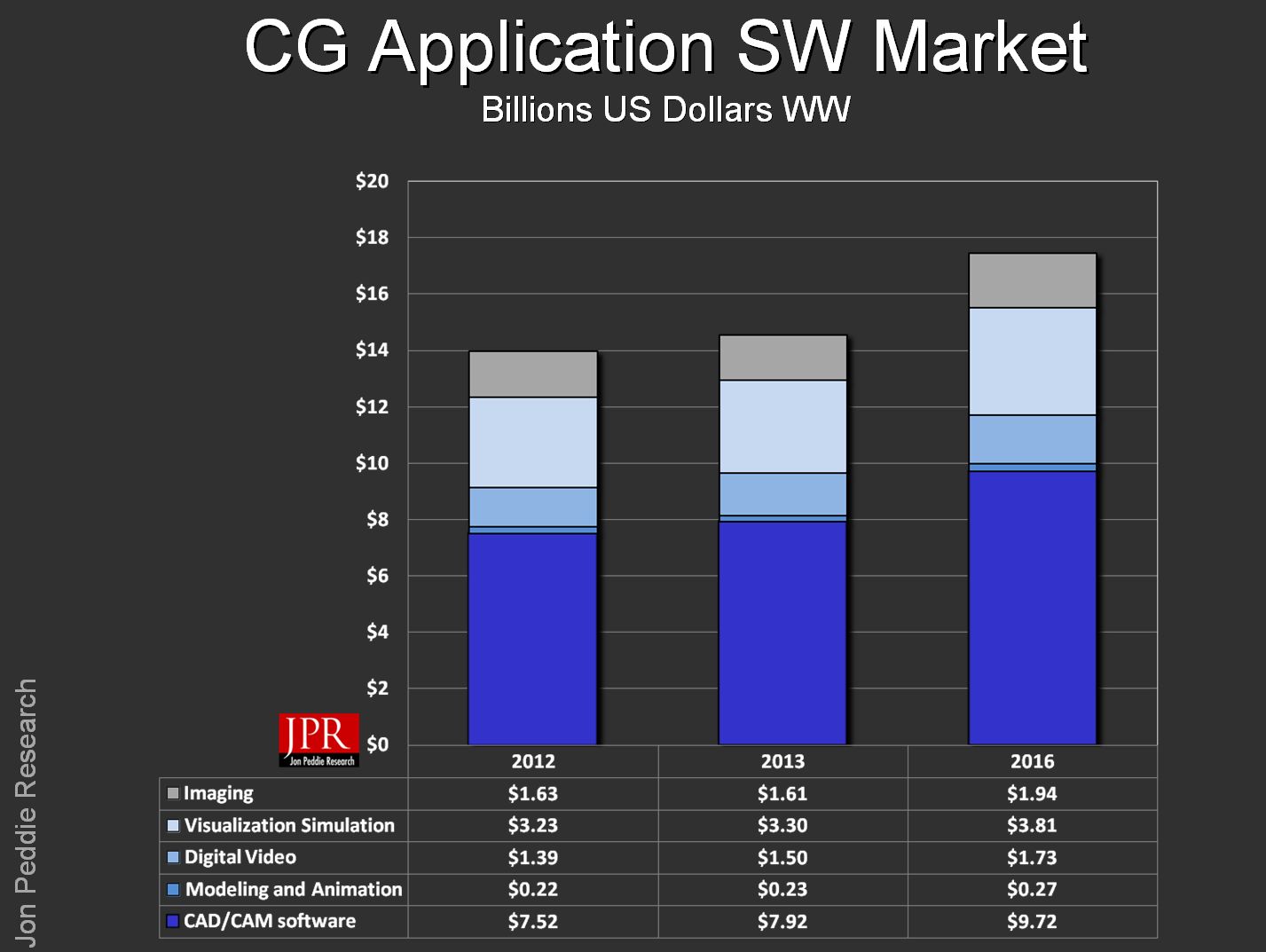
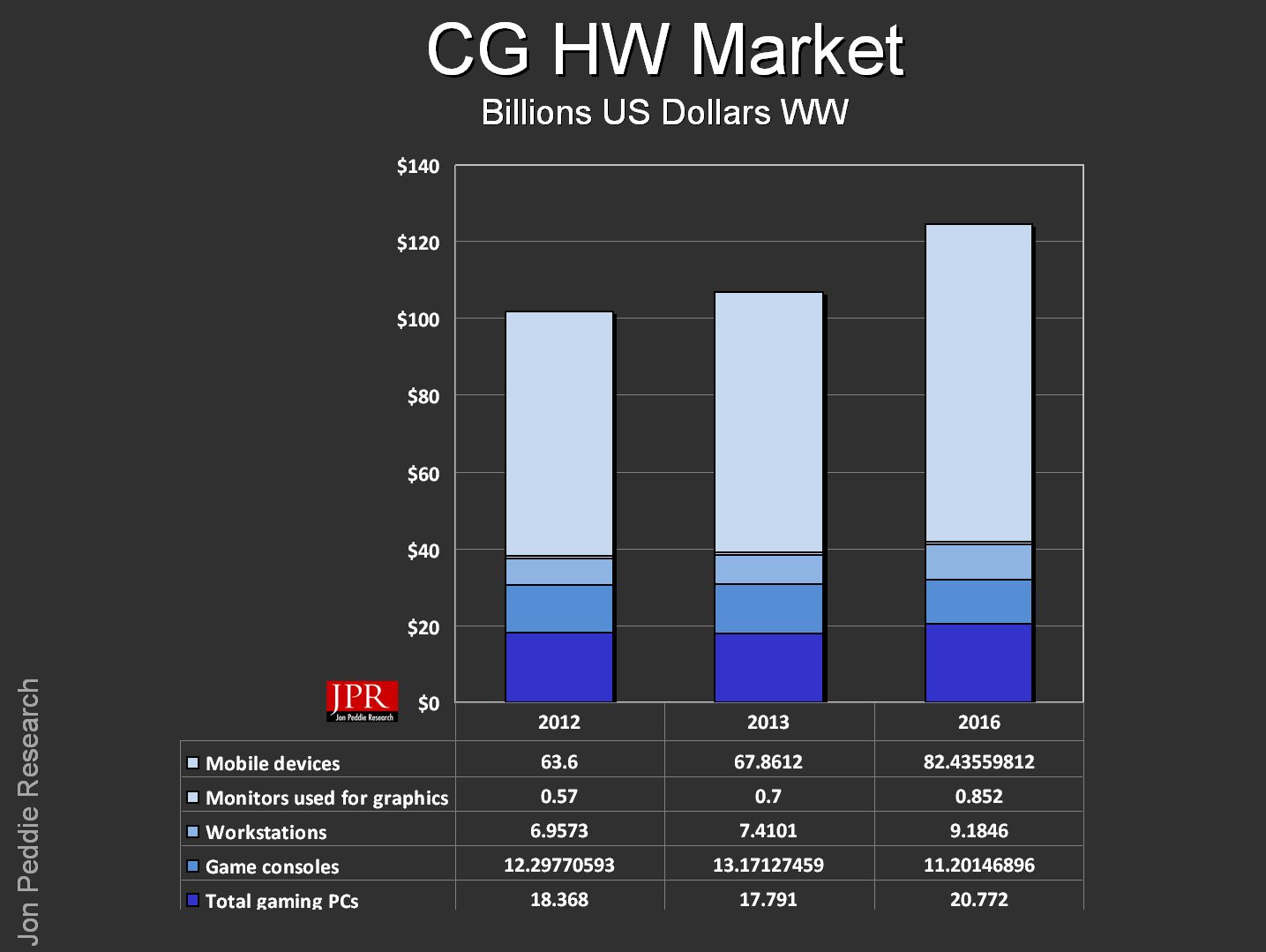
July 24, 2013, Siggraph, Anaheim, CA—John Peddie from JP Research provided a market overview and held a panel discussion on the democratization of CG tools. One difficulty for the industry is that the Siggraph conference is declining over the past decade, for both exhibitors and attendees. At the same time, the value of CG apps grew 5 percent to $14 B in ’12 (See figure 1). The CG hardware segments are expected to grow to over $105 B in ’13 ( see figure 2), and possibly in the next year, we can expect to see tablets used for the creation of computer graphics in professional spaces beyond the consumer level. One driver for the change will be the growing acceptance of Windows 8 for all platforms.
The markets for CG software are growing in all sectors
The panel was moderated by Kathleen Maher of JPR with the main topic of “Democratization, is it a good thing?”. Panel members were Lincoln Waller from Dreamworks, Joni Jacobson from Pixomondo, Jim Herman from Legend Animation, Michael Romey from Zoic Studio, and Paul Navratil from TACC. The main issue for the panel was the changes in markets and accessibility for the CG design tools.
CG hardware continues to be a growing market. Next year, expect to see more in tablets.
The digitization of images has led to increased fluidity and easier transfers, leading to greater access to more users?
Jacobson suggested that the increase in visual effects allows the studios to move their work to other areas to reduce costs. This change is disruptive to the artists and changes the economics and labor structures of the industry. The result is an unleveled playing field where the artists are being left out.
Deal structures? Advent of transmedia and business constraints?
Romey noted that the markets have changed. When they were making “Once Upon a Time” a single episode might have 300 visual effects. This volume of effects allows the artists to be more artistic. The growth of virtual production on a green screen improves the production efficiency and allows for more shots, leading to line tracking. The addition of mobile devices like the iPad provides virtual locations to the artist, director, and cinematographer. In addition, the show assets can be repurposed for games, and other transmedia projects. The new creative environment is a blend of technology, software, and methodologies.
Workloads?
Waller commented that there are many possibilities for parallel jobs. The concerns about the studios outsourcing raises issues with collaboration and accessibility. To run a production back-end needs scheduling and fast links to the assets. Scaling can help reduce costs in the creative pipeline.
Jacobson retorted that companies are still using the same boxes, just trying to add flexibility with people throughout the world.
New markets?
Romey suggested that globalization is increasing the markets, and when coupled with data mining, can build systems that reduce costs, labor, and time for the new processes. Other issues like storage still matter.
Navratil considered scientific visualization to show concepts as a market for CG tools. People process about 80 percent of all data through our eyes, and cinematic quality graphics for visualization through graphic accelerators could show the data form supercomputers.
In addition, scientific computing itself is moving towards CG. Researchers are networking systems across the full flow and processing data across the parallel machines. One reason for this move is that the data are not boxed data, but cover a range of values.
Herman offered demonstrations of the tools themselves as a new market. The high-end equipment for an artist’s work is now available in the cloud, so difficult tasks like color grading are available to anyone. With access to the tools, almost anyone can create 3-D images. Creativity is now a facet of problem solving.
Waller objected that an artist can run production. The studios create content for markets and transfer other processes across many levels, which allows for random creative processes within the system.
Jacobson agreed that different cultures and transfer management are needed to get content created in a global environment. The tools are necessary, but not sufficient for a production flow. It takes time and effort to integrate the functions in other areas into a working flow. E-mail is not good for management across cultures, so person-to-person contact is required. Distance increases the communications complexities.
Navratil noted that divorcing the co-located creative and the tools just moves pixels into the content. There is easy to transfer intent and interoperability.
Romey added that tight deadlines are making studios add data mining and tracking to their production flows and then use those patterns and datalogs to predict and scale their systems. The users need flexibility to check the patterns and respond. Adding session metadata provides context to the data.
Too much information and chatter?
Waller stated that technology used to be driven by the military. Now, entertainment drives hardware and software requirements. Global apps and data structures, etc. change functions. Siggraph doesn’t talk about IT and enterprise systems, but about key networks and tool flows.
Email as communications tool, artist versus engineer centric?
Waller commented that artists started with paper and moved to CPUs. This move relaxed constraints, but now we are getting back to tablets, just electronic.
Herman agreed that the democratization of tools and distribution helps to put lots of information on the Web, so most users don’t need Siggraph. Anyone can reach a large mass of people with little effort, which opens access to consumers.
Romey noted that hardware allows artists to iterate. The new distribution mechanisms open more markets and distribution channels.
Navratil stated that some companies are releasing a full season of content in one go. If the channels exist, the creators can get content out. The challenge is how to curate all this content. conferences need to address these types of topics.
Media changes?
Jacobson mentioned changes in technology, distribution, and availability. The technologies make everything available. the media companies are investing while reducing budgets to tryp t not copy the record industry’s downfall.
Waller claimed that the physical world has s different product creation and distribution model. Digital is not physical so it changes the nature of the content. for example, games started on cartridges then moved to CDs and DVDs, and now are on networks. New game models include mobile and freemium. These changes in consumption models raise other issues like piracy.
Herman interjected that the new models still have to make money. The hit games on a free to play model are creating virtual currencies.
Romey considered that there are packages for networks for such functions like on-demand render that is moving into mobile. The data are mined for information on viewer location, hardware, etc. The broader market is changing content delivery models for games as apps in the cloud. These new models tie ads into the content.
Navratil declared that the pitfalls in the new models are that the value add cuts out the middlemen with the Web. There is an issue with good enough for a medium versus excellent. Netflix created “House of Cards” which is good content even if it might be watched on a mobile device.
Jacobson noted that the pilot episode drove the series.
Herman declared that the technology and business models are inhibitors to further changes. For example, GPU render farms on the cloud freeze the technology at a point in time.
Navratil offered science centers are making more public-private partnerships and are getting access to clusters of hardware.
Waller suggested that media are constrained by devices and inhibited by software limitations. Orchestrating resources is a challenge that can be addressed by better systems and network architectures.
