


Software-Defined Networks and Storage
September 16, 2013, Storage Developer Conference, Santa Clara, CA—Stuart Berman from Jeda Networks talked about the software-defined network and its impact on the future of storage.
The emerging cloud model with resource pooling, dynamic allocation of resources, multi-tenant, software deployment, automation, and management is creating new requirements in economics, speed and scalability. Enterprise data centers are following this to lower costs and increase resource use. These systems are all interconnected with an Ethernet fabric.
The resulting software defined network (SDN) is supported by new networking architectures that can grow with the traffic. These systems are tied the other with automated, multi-vendor methods for configuration and management. The SDN has a high level abstraction of the network switch control plane. The virtual network abstraction overlays the physical network, which hides the complexity of the physical network.
The same principles can be applied to storage networks, which are defined by the application workload requirements that run on top of them. SDNs are not suited for single the application architectures with very low cost workloads an enormous scale, and nominal cloud applications. These applications are easily addressed by the performance capabilities of commodity hardware. The SDS can be configured for highly resilient, high-performance enterprise workloads. See figure
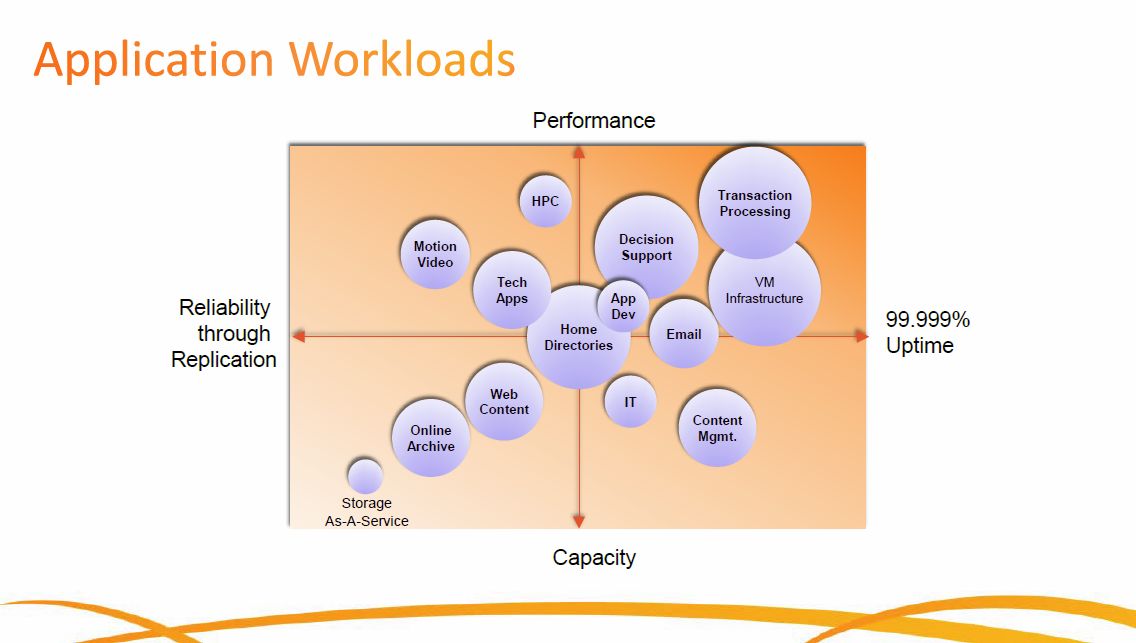
Caption: The bubble diagram shows various performance and reliability requirements for various types of applications.
The main problem is that there is no easy way to cross from one quadrant to the other, since there is little correlation between performance requirements and cloud capabilities. Dedicated, high performance hardware will always cost more than commodity hardware, and the commodity equipment has difficulties in meeting the performance requirements of the high-end equipment.
It is still possible to apply the concepts of SDN to storage networks, by decoupling the control plane and essential SAN services from the underlying hardware. The logical and consistent behavioral representation is overlaid on the physical network. The resulting SDS is an abstracted and simplified storage network with configuration automation and reduced complexity, all running through the data center Ethernet fabric.
One key requirement is a storage SDN controller. This control implements global SAN services, communicates with servers and storage arrays, interfaces with switches to create a high-speed, secure storage network, and contains a global view of the network. Existing network LAN management tools will still work in the system, supplemented by LAN and SAN network management on a single console.
These management tools ease network troubleshooting by providing centralized storage network control plane visibility and monitoring. The tools will require any changes to storage array or server storage management practices, and leverage current network traffic engineering. The SDS is essentially another virtual machine in the SDN.
A software defined to storage and network is highly scalable, since the SDN is an abstract storage network overlay. The data center Ethernet fabric core provides the required high-performance application to storage connectivity from any virtual machine to any virtual storage node. In addition to ease-of-use and scalability, an SDS provides capx savings through the elimination of specialized SAN switches and associated software licenses.
After these modifications to the network, it’s possible to bring cloud benefits to the enterprise and high-performance environments, through the elimination of one hardware layer and its associated latencies. Although the network configurations for the high-end systems is likely to remain unchanged, creating a SDS for these systems simplifies storage and storage management.
Storage SDNs will transform the way applications connect with high-performance storage. They can be deployed in clouds, enterprise, or SMB environments. The software defined storage network is in reality just the evolution of SAN.
