


Multi-primary Color Calibration
February 2016, Electronic Imaging, San Francisco—Carlos Eduardo Rodriguez-Pardo from the University of Rochester described a procedure for calibrating displays with more than the standard 3-color displays. The challenge is to provide a display that still has a continuous color spectrum.
The current mode of 3-color displays has some issues with realistic matching to human vision. Adding additional colors to the display offers the opportunity to create other colors within the gamut by using different combinations of primary colors. The problem is that the use of different color primary combinations may impact other display attributes, which result in color and intensity anomalies.
The multi-primary ( four or more color primaries) displays need to have the various intensities mapped to a standard control space that differs from the normal 3-color displays. The problem is in the math, a 3-color display uses a non-singular 3×3 matrix while a larger set of colors creates a non-singular matrix. The effects from the higher order of matrix is that the control matrix cannot uniquely define a unique control value for any color.
As a result, the multi-primary displays need some type of calibration function to define the color gamut and provide smooth color transitions. Since the calibration function is based on a sparse matrix, it is not continuous. This piece-wise liner representation becomes evident in non-ideal multi-primary displays that have been simulated in various testing and through a mathematical model.
The calibration functions of more than 3 variables cannot be directly visualized, but systems with 4,5, or 6 primaries can use a subspace decomposition for the control space. The visualized control space is a K x (K-3) matrix whose columns represent a control black space which contains the differences between all alternative calibrations for a color. By using a smaller base matrix plus a correction matrix to account for the additional color primaries, the algorithm can be set up to provide a robust and smooth display control function.
The results of actual testing and comparisons with other methodologies including matrix switching 
is obtained by discretizing the calibration function over a uniform grid of points covering the entire display gamut and using the gradient descent
algorithm to numerically perform the minimization. See figures.

The gray ramp images show the errors inserted by various calibrations


The color ramp clearly shows how differnt calibrations affect the color of the image

The figures show that the various calibrations suffer from simulated device variations through the injection of up to 40 percent noise to the starting value. The table show the gamut variations for each type of calibration.
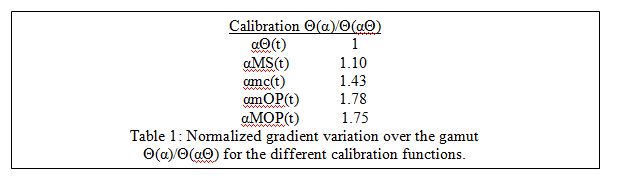
The test results indicate the need for robust color reproduction and calibration for the displays. Optimizing the calibrations for multi-primary displays needs a methodology that offers the smoothest variations in the control value sets over the entire gamut, as well as robustness across display variations. The mathematical basis for this calibration has been shown to meet both requirements.
