


New Graphics options at GDC 2014
March 2014 – At Game Developers Conference in SF this year, there were many developments in the graphics community. New additions include ray tracing, hybrid rendering, integrated lighting, 4K display, and DX11 support in the new Baytrail processors for Intel.
Imagination Technology was showing their Wizard (formally known as Rogue) GPU which is their ray tracing (see whitepaper for details) optimized GPU for the mobile marketplace. The device supports hybrid rendering along with raster mode for shading and lighting. The light mapping, including indirect lighting support, has been integrated into the Unity 5 engine. Using this GPU, the render no longer needs a light bake cycle.
Imgination Technologies Hybred Ray Tracing
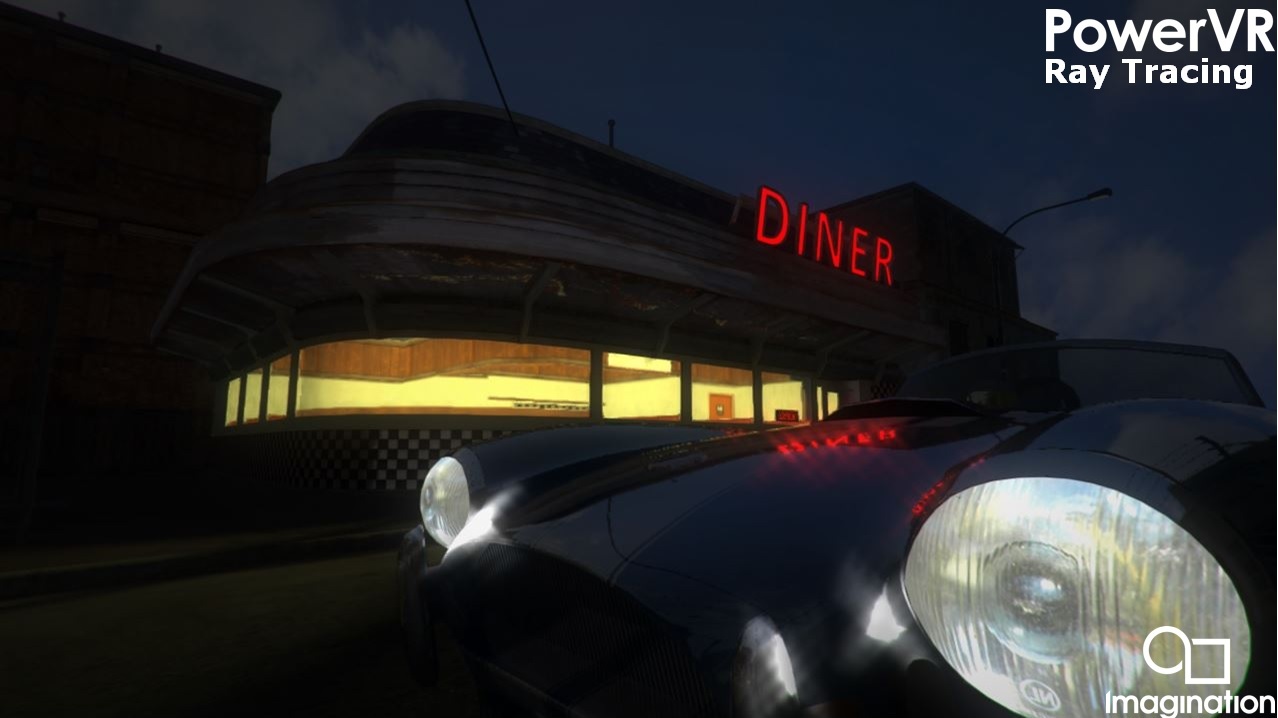
In addition to the new GPU, the release of ES 3.1, allows for functions such as face detection and other vision processing tasks to be done existing GPUs. These existing solutions are in many mobile devices as well as those deployed in LG TVs. The hybrid render that is in the Unity 5 engine supports both the ray tracing function and a raster solution. For existing GPUs, the raster function support traditional shadows and lighting. With the Ray Trace engine, the system generates multiple rays per pixel and results in soft edges and reflections only of objects affected by the light. In raster format, it estimates the indirect lighting.
ARM lead with the announcement that they had acquired lighting software leader Geomerics which is integrated into the Unity5 engine and has optimization for the Mali GPU (T604 and newer). The Geomerics engine utilizes Open GL ES 3.0 extensions. Other advancements being shown included 4K displays from Scaleform flows on Mali450 and higher GPUs. These are typically found in TVs and with the new flow, support native render at the TV set.
On the area of extensions, their current generation of GPUs supports Open GL ES 3.1 which has the interface to many of the physics based functions for the graphics objects. These extensions are supported by their new transactional elimination engine. The GPUs now support a tile based render optimization that analyzes movement on the image and then only remaps the portions that change to the render engine keeping th rest static. This can significantly reduce the redender requirements and hence the power needed to display an image set. This capability works with any application that goes through the GPU and allows the memory buffer to just reread rather than reload. Rounding out their announcements was their new texture compression capability which has finally been realized as the GPU cores with the capability have finally made it to production.
Qualcomm was showing tablets that supported full 4K displays from the GPU with a quad core CPU. The units were shown both with pre-release gaming content and movie playback content. The 4K display tablets also supported surround sound processing. The Adreno GPUs shown at the event did not have an update as to which would be supporting the Open GL ES 3.1 release, but it is anticipated, that their GPUs supporting Open GL ES 3.0 would support the 3.1 update.
Intel had their mobile update. Starting off with the largest current installed base of computers is PCs, they highlighted some of the platform penetrations with 75M+ on PC for World of Tanks, and 100M+ for Minecraft on the platform. The new core processors – the Haswell class and the Baytrail class both have integrated GPUs. These support Pixel Sync and both render and shader engines. These enable Ultrabook to high performance display the same time as touch and gesture recognition along with full Open GL ES 3.1 support. These features give DX11 level performance on Android. At this time, an Android official update is needed to access the ES3.1 features. The Haswell i7 processors support Advanced Order Independent Transparency (AOIT) and Direct Resource Access (DRA) which is much more flexible in an HAS application than just a DMA interface.
On the BayTrail tablet platform, using the current release of Android, the ES 3.0 extensions allow for HDR (High Dynamic Range) movie playback, Bloom lighting effects, hardware instancing and up 64K shader particles. The target market is for Intel to have installed 30B units by 2030.
