


Nexia Connects across Vendors
May 2015 – At the connections conference, we met with Nexia to get an overview of their connected home platform. Their system, unlike most in the marketplace, has a DIY aspect, but is primarily targeted at the professional installer channel. The system is built around a gateway and cloud solution that is fairly agnostic to endpoint control device manufacturers, so it supports a large ecosystem of suppliers. These suppliers are in the door lock, thermostat, lighting, and outlet control areas.
The idea behind this business is to utilize the trained professional installation channel that installs & supports Trane HVAC systems and Schlage entry control systems to set up the home automation. This simplifies the installation and the configuration for the homeowner. One of the simplifications provided by this arragnement is the use of Certified Nexia program connected devices. While the thermostat co-located gateway incorporates a standard Zwave hub, there is a proprietary protocol for the Nexia gateway that needs to be addressed by the endpoint devices. Their Certified Nexia program verfies that these devices work properly. Examples of the Certified Nexia products include windows and shade systems from Pella and Anderson.
Nexia Home Intelligence
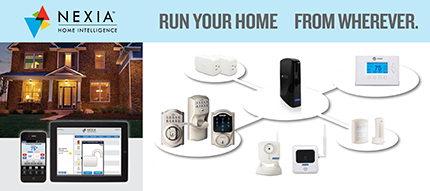
Their system has 3 outlet paths for distribution of the products and services :
1) The trained HVAC installation service that installs and configures the Nexia thermostats with the integrated gateway. This is the primary channel for existing houses that are adding connected home capabilities.
2) For the integration into the new home communities that have an association with the National Builders channel. In this environment they work with developers to do parts selection and placement planning.
3) For an ecommerce outlet, they use Amazon. Amazon operated a live call center and trained support on a monthly fee.
The network gateway supports both a wired or wireless interface to the internet for being able to push control information and data to the cloud. The data is then stored for use in supporting the environment and for automated control. The system is secured by the use of call out and call back configuration which is used to upload data.
