


SpeechTEK – IVR to Natural Language by Damien Stolarz & Josselyn Boudett
August 2015 – At SpeechTEK (http://www.speechtek.com/2015/) in New York City, evidence abounded of an industry on the cusp of significant disruption. The conference, co-sited with other customer service oriented events (CRM Evolution and Customer Service Experience), was oriented towards the kind of traditional speech solutions that have been making money for decades, namely customer service voice applications. But the presence of the major Internet companies could be felt, with speaker after speaker in interviews and talks comparing traditional telephone interactive voice response (IVR) to “Apple’s Siri, Microsoft’s Cortana and Google Now”.
Many of the talks had the same theme: The industry was dealing with the transition from DTMF (touch tones) and “directed dialog” to natural-language (NL) dialog interactions. Consumers are becoming accustomed to highly interactive, conversational, agent-based interactions with their smartphones and are beginning to expect the same interactions when they call customer service.
There are technical issues that aren’t clear to the average consumer. Creating a dialog system that will solve customer problems such as booking a room or paying a bill is a very different problem than creating a search system or a ‘bot’ to have witty conversation. And the fidelity of voice over a traditional phone line is quite different than the rich, full-frequency, audio available to a smartphone app.
Several of the talks addressed traditional IVR problems, such as how to increase containment (a euphemism for “not letting you talk to a human”). A big emphasis in talks was on collecting data and really being able to analyze it. Customers often come in saying “we want to increase satisfaction” and yet they have no current way of measuring it, and thus wouldn’t know if it improved. But the data collection also served a greater purpose. While some systems create large logs of data that have to be manually analyzed, some vendors are already using this information to re-train their systems, either through automated post-analysis but in the best cases, the data is being automatically integrated. While some of the more scientifically-minded speech experts bristled at “deep learning” being thrown around as a mere buzzword, many of the presenters made it clear that it isn’t just the search engines and smartphone manufacturers that have a handle on “big data” and analyzing voice interactions to improve the system. A possible takeaway from this, however, is that the companies with the largest databases of past speech interactions may create a formidable barrier to entry by having the most experience to draw upon in their machine learning.
Omni-channel was probably the biggest buzzword of the conference. Just as the content delivery folks had to figure out a few years ago how to pause your show on the TV and resume it on your mobile, true customer service requires you to keep track of voice, text, email and web based interactions and not lose context between them. No one wants to chat with the help desk online, give all their info, then call a number, authenticate again, and finally get to a live agent who asks them to repeat it all a third time – and who can’t access the email they sent with all the details of their issue! We spoke to several vendors who attempt to do this, either through a large, monolithic super-solution or through a bit of glue between disparate vendors. Either way, it is recognized, if not completely solved, that omni-channel solutions are going to be a tremendous brand differentiator and eventually, through competition, become a required feature of CRM.
Some other repeated themes in talks were ‘discerning intent’ and ‘sentiment analysis’ Attempts to get an inventory of the actual techniques being used were unsuccessful because of the wide range of expertise and focus at the event. One presenter might be from marketing; the next, a speech recognition scientist who considered speech the most important part and considered dialogue management someone else’s problem. Many were confused by the question “how does your dialog manager work” or “what AI techniques do you use to carry on the conversation” because there are too many – the entire toolbox of NLP (natural language processing) techniques, machine learning techniques, and thus it was difficult to compare ‘apples to apples’ between the different vendors of agent software.
Overall, the sentiment of the companies presenting was quite hopeful, and the intent consistent: bring natural language human interaction into as many products and computing environments as possible.
Interviews
We caught up with several industry leaders, including the following:
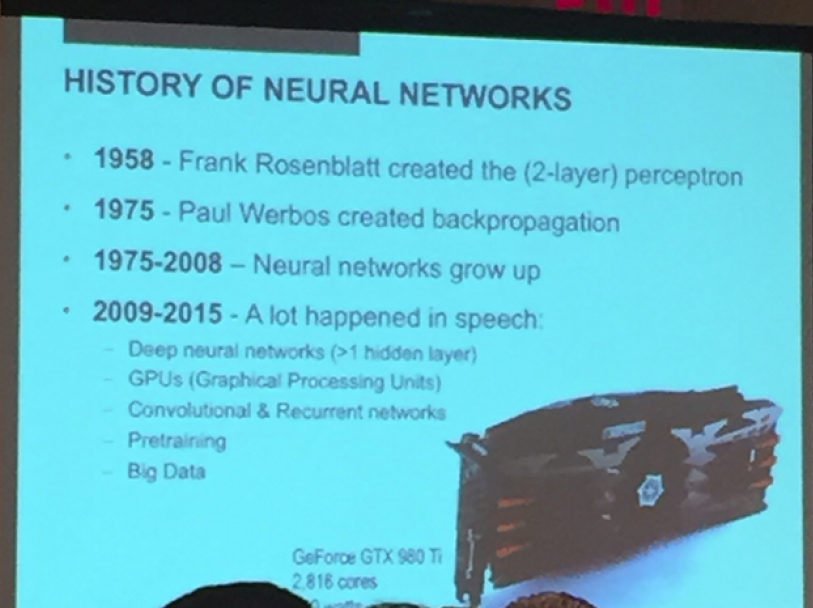
From Interactions Corp (http://www.interactions.net), Jane Price and David Thomson, VP of Speech Research, led us through their platform and technology. David had given a deep talk on deep neural networks (DNNs) and their dramatic impact on improving speech recognition over the last five years due to the exponentially expanding availability of interaction data with which to train them.
SpeechTek 2015- History of Neural Nets
David was part of the AT&T speech group that was acquired by Interactions late last year. The report is that the teams are delighted to be under one roof, and they are enthusiastic about their product roadmap and market strategy in the months and years to come.
One of the most interesting factors about Interaction’s platform is their use of people in the role of “Intent Analyst”. Their learning system is able to bring in human operators transparently behind the scenes to decode sections of spoken dialog that the computer recognizer feels it doesn’t have a high likelihood of getting right. The human resolves the ambiguity or selects the intent (say, if a user was trying to say yes or no, but said “I don’t think so” with background noise”) or if the user was telling a nearby person to be quiet. The system then adds this human-annotated recognition to a database in real time and learns from it, without needing post-processing.
Fun fact was that their system powers the Hyatt automated reservation system. I was pleased to learn that the fake ‘typing’ sound (a form of ‘comfort noise’) that plays when the computer is thinking, might actually be covering for the delay of an agent figuring out what the computer couldn’t. Clever.
Like many of the attendees, Interactions echoed the sentiment that they have been focused up until now on mission-critical IVR with transactions involved. They also noted that the market is expanding, with IoT (Internet of Things) and potentially voice-responsive objects opening up new market categories to explore.
Among the first people popularizing the term “Visual IVR” was Chris du Toit of Jacada (http://www.jacada.com). Another omni-channel provider, he led us through how much quicker multi-modal service can be, and how important it is going to be to maintain user experience context across web chat, IVR and mobile interaction. Chris showed us how their software stitches together the experiences of deployed, legacy IVR and customer support systems and unifies them without having to re-engineer them, no small feat. Perhaps the most interesting observation was that millenials in particular are much more chat-oriented and are not habituated to calling and talking to an IVR to accomplish their customer service goals, and tools like Jacada’s are responding to this broad change of preference.
We met with Wayne Scholar, the CTO of GetAbby (http://www.getabby.com). Their agent technology is used for enterprise and personal virtual agents, health care agents (such as http://mycarenavigator.com), and even in-store kiosks. He described how their omni-channel (voice, text, web) avatar-based agent is backed by a scaling AI engine. Even across different verticals, the system learns from the big data collected across all these interactions.
We got a chance to speak with Jason Mars, an assistant professor at University of Michigan. He gave a talk on Sirius (http://sirius.clarity-lab.org) , an open-source intelligent personal assistant (IPA) platform. Jason was incredibly energetic and interested in explaining the topics we asked about (he is a professor after all), and went on to describe various projects the students were working on, including a query engine that could answer any data question from Wikipedia. One of the more interesting insights Jason gave was that many of the breakthroughs in intelligent agents have come not from AI research but rather from research into scaling computing platforms. Jason is actively looking for early stage companies who might collaborate with the University of Michigan toward R&D or product development.
We ran into some very unique technology in talking to Alok Kulkami of Cyara (http://cyara.com ). Based in the Silicon Valley they’ve apparently created the first set of robots that dial in to an IVR and test all the options. This is like an “audio screen scraper”, robots calling robots to talk to them and see if they are doing their job right. They can use it to reverse-engineer legacy voice systems, and also to create unit tests. You provide the robot with an identity, a social security number, mother’s maiden name, other credentials, and they log into a system and perform normal operations. In the future they could make a robot that calls and does tasks on behalf of a user, and I asked whether they could integrate with IFTTT and fully automate systems where you have to talk to someone or an IVR. Alok’s background is in dashboards for call centers. The Cyara system deploys very fast, several weeks, which is great in an industry that can take months to re-factor an IVR system to improve customer satisfaction. They have very interesting tech.
