


Kalray brings many-core processing to new applications
February 2016 – In a casual lunch time briefing, we had a chance to get an update on the companies processor IP and their market application areas. As counter trend to the multi-core marketplace for processors, the company has instead chosen to follow the path of the many-core processor. The company is headquartered in France as a spinoff from CEA and with a current management team from ST, the company has also taken up offices in the US and Asia.
The difference, at the high level, between the two architectures is: Multi-Core – more than one core that share a common cache, have a shared memory fabric and require not only multi-threaded but partition-able applications to take a single memory load, and pass it coherently to the different processors trying to solve the problem; and Many-Core which is essentially a server rack in a chip – it is a large number of independent processors that share the overhead of I/O paths, but solve simultaneous non-overlapping problems without memory sharing and any of the memory coherency issues.
Kalray Many Core Processor High Level Architecture
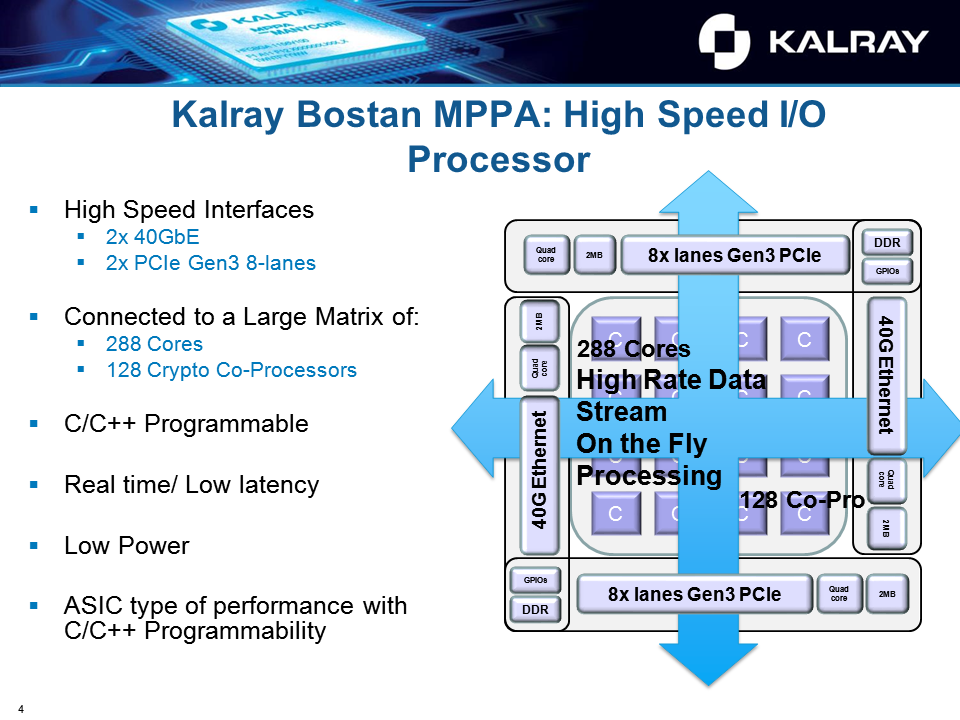
The processor was first targeting the embedded mission critical applications that depend on multiple independent solution processing followed by a voting circuit to determine, by majority rule, the correct answer. In these applications, common clocking and I/O on independent processing is a natural fit, and lead to many real time applications.
They retargeted the marketing efforts of the device to include the data center. In this case, the creation of a smart NIC, and storage interface market with NFV and SDS were also a good fit. The many-core processor is highlighted by its configurability with high level languages such as C and C++. This allows a single piece of hardware to be used for multiple functions.
To support this market, the processor has a full set of software tools and compilers including debuggers and trace functions. All of these tools are comply with the GCC standards inside the GNU licensing structure. The software supporting the processor is designed for applications running under Linix, esol, posix Operating Systems and Open CL, Open Data Plane interoperable application space.
The parallel workflows in the enterprise being addressed include partitioning and retrieval for Hadoop, NVME or VME over fabric, de-dup, NVME over IP, object data base processing, RAID configuration offload and PCIe centric encryption offload.
