


Rivet Networks addresses the big bottleneck in gaming
February 2016 – Rivet Networks, the new owners of the Killer Wireless technology, was talking about their new networking product. The Killer Wireless technology has been updated to support the 802.11ac (killer wireless-ac 1535) standard and the same packet management technology has been integrated into their Killer Ethernet (E2400) product. The combination networking chip, supporting both Ethernet and Wireless, is called the Doubleshot-Pro.
The company started in 2005 as Bigfoot Networks creating a standalone network and wireless cards. The Killer Wireless technology and the company were acquired by Qualcomm in 2011 and expanded into the OEM space and included the development of the StreamBoost technology . In Dec 2014, Rivet Networks took control and spun the technology out from Qualcomm, while retaining the original management team from Bigfoot Networks. The spinout included an engineering team comprised of members from Intel, Microsoft, Polycom and Qualcomm. This is the team that is driving the networking control interface to new markets and new applications.
The technology that is in these chips allows for user control of packet and application prioritization (high, medium, low) and bandwidth control. This allows media centric tasks – gaming, video, conference communications, can be set to get the bandwidth they need while still allowing the rest of the people on the network, some bandwidth to still be able to do their tasks.
New standard technology, such as 802.11ac have improved wireless communications to higher speeds, lower packet loss, higher connectivity through beam forming, lower power per bit transferred for communication in general. What the Killer Wireless technology, and the Wireless-AC 1535 chip does, is allow a user to allocate a priority for Skype or for real time video streaming and gaming, vs background tasks such as backup and video downloads that are not real time but going to a DVR or storage function. The results of the use of the technology can be as dramatic as allowing higher resolution images on skype (1280×720 vs 640×380) while having less latency (15ms vs 172ms) which changes the entire QOE of the session.
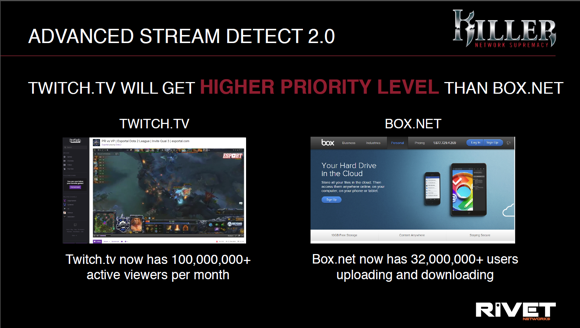
Most of the technology breakthroughs on the standards side are related to the improvement of download speed while still keeping upload at 1/10 that of download. While this is a key improvement, upload speeds are a limiting factor in the current mobile marketplace. Photos, videos and music captured live on the cell phones need to be pushed up to social media and to cloud based storage. These tend to be hundreds of MB in size and GB in size in some cases. In gaming, the nominal play is big download, then small up and down traffic to have the character motion control go through. Most people only optimize for the start of scene download.
The reality of those who are hard core or serious gamers, in both mobile and console markets, is the capture of the game session and push to the networks is a major issue. Twitch.tv is now a dominant cloud destination for game video and active competitions like eSports. The traffic on Twitch.tv is long run vs the short content that is uploaded to social media and YouTube. The mobile generated content may be shorter, but there is more of them, so application based prioritization is a key. The Killer technology allows for the packet prioritization on BOTH up and down packets in wired and wireless connectivity.
The current Killer technology solutions are available to OEMs for the gaming and video marketplace. As media becomes more pervasive as a bi-directional data format, the technology is rapidly being targeted to new applications and markets.
