


AWE bring wearables to the AR/VR show
June 2016 – This year’s Augmented World Expo focused on the realization in the market. Conference founder Ori Inbar and member of SuperVentures VC explained that both AR & VR are in production, and more importantly, there is content and applications to used and viewed with the hardware. One of the major advancements in the past year was the AR marketplace and its penetration into the industrial marketplace.
The assertion at the conference from augmentedreality.org, was that the AR marketplace would reach $1B by 2020. Drivers to this level include new additions to the marketplace by user created content companies such as Snapchat. Entering the marketplace were over 32 different AR glasses that have been optimized for multiple sectors. Also, companies like Epson, with their new AR glasses the Moverio-BT300. This next generation product is the result of 5 years of market feedback and customer feature requests on the industry leading Moverio-BT100 which was released in 2011.
Augmented World Expo – AR Development Ecosystem
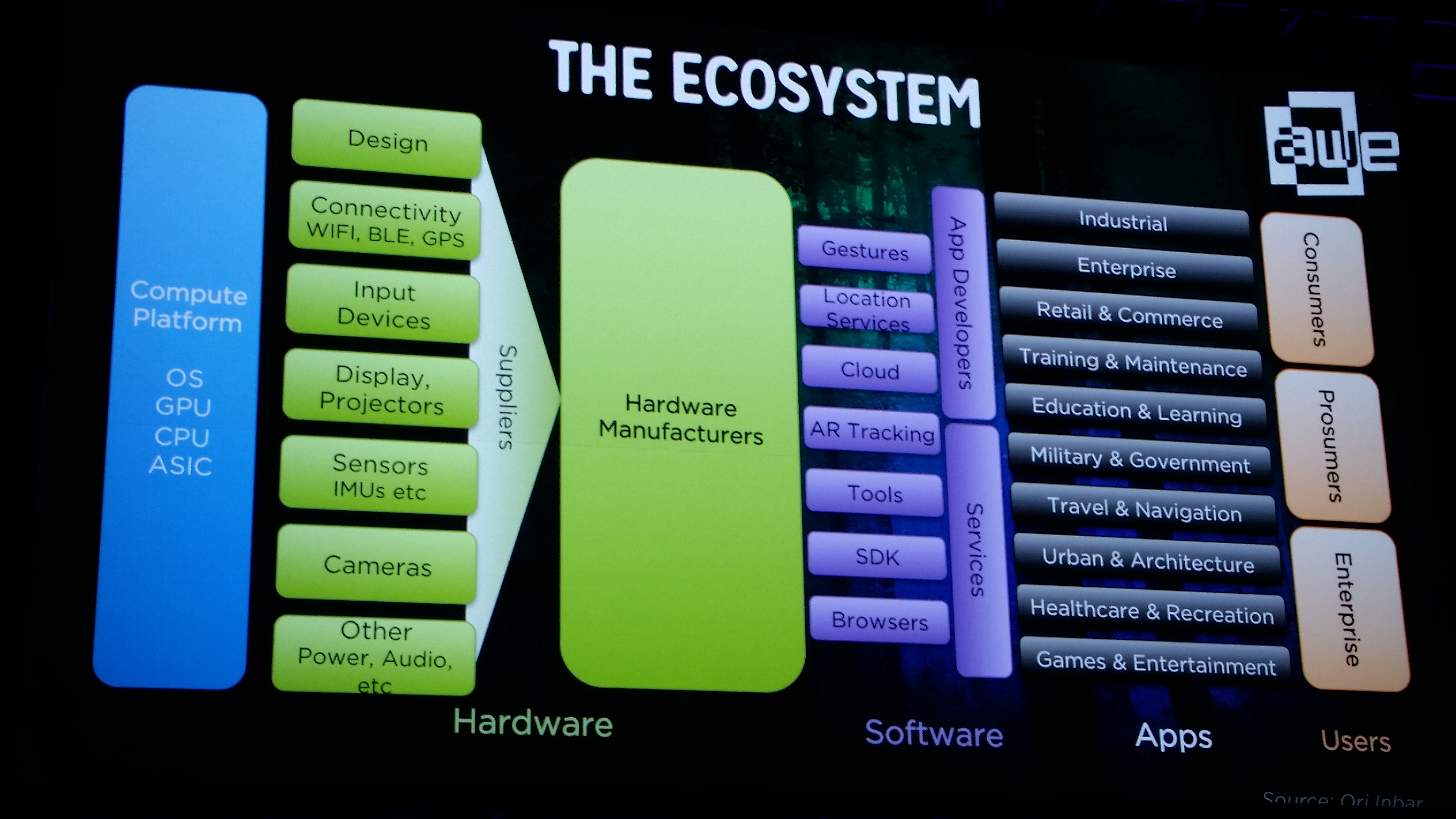
Another major shift in the AR marketplace was the creation of a new workflow and ecosystem. The ecosystem starts with compute resources, function specific hardware, software tools & services, specialized application vertical markets, and finally 3 classes of users – consumers, prosumers & enterprise. The computing resources would be both local and in the cloud, and was hypothecated, by the conference, that VR/AR and wearables devices will consume 100% of all personal computing and customer facing compute resources replacing and eliminating all current installed home computers & tablets and non-web servers, within 5 years. The prediction on the consumption of computer resources was a high topic of debate and discussion amongst both vendors and attendees at the event.
Along with the computing prediction, the conference opined that, due to the high level of investment by the VC community that a major shakeup in the adoption of headsets and eye ware across both AR and VR applications was coming. They indicated the shakeup was happening over the next 6-12mos, overlapping with the holiday sales period for consumer electronics, and will result in the global headset adoption approaching the inflection point where smartglasses will replace cellphones and smartphones with over 1B active units sold and in use. They opined this 50% installed market infection point towards smartphone replacement was to be achieved prior to 2018.
One of the enabling technologies for these new glasses is the availability of OLED and AMOLED displays. These provide increased transparency while providing higher contract, better color and supporting higher frame rates at a lower power profile than TFT displays. These displays are being supported by software platforms like the Re’Flekt VR platform from Bosch. Re’flekt has released the Reflekt360 interactive game and Hyperloop AR/VR engine. This is being used to enable both consumer and industrial AR projects and has been designed to support scalability in the IT applications.
These shifts in the marketplace are the start of the rise to the inflection point to bring AR & VR to our daily lives. This concept was the theme for this year’s show – Bringing Superpower to the people.
