


SMPTE and NAB show off HDR
April 2016 – One of the themes of the 2016 NAB show was the workflows and products for High Dynamic Range content. As content moves to 4K and 8K resolutions, they are also observing the ITU-R Recommendation BT.2020, specification. Known as Rec. 2020, it specifies two resolutions of 3840 × 2160 (“4K”) and 7680 × 4320 (“8K”). These resolutions have an aspect ratio of 16:9 and use square pixels at the following frame rates: 120p, 119.88p, 100p, 60p, 59.94p, 50p, 30p, 29.97p, 25p, 24p, 23.976p as acceptable for playout. In the new specification for the higher resolutions only progressive scan frame rates are allowed.
One of the major components of Rec 2020 is the increased color gamut. Rec. 2020 defines a bit depth of either 10-bits per sample or 12-bits per sample. The 10-bits per sample Rec. 2020 uses video levels where the black level is defined as code 64 and the nominal peak is defined as code 940. The 12-bits per sample Rec. 2020 uses video levels where the black level is defined as code 256 and the nominal peak is defined as code 3760.
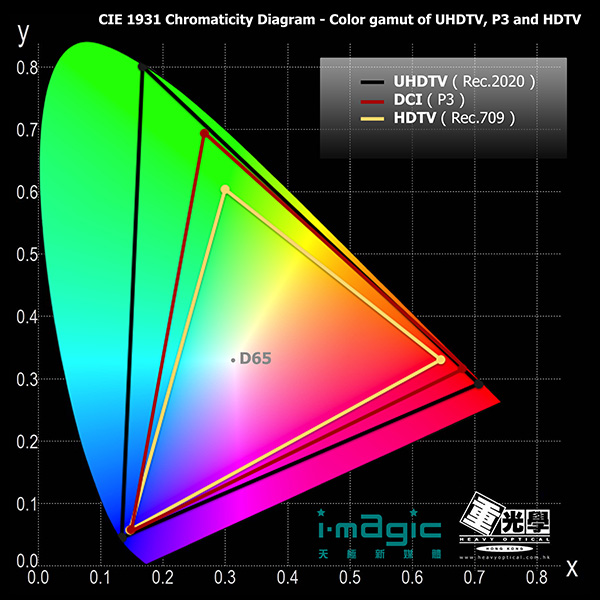
Since the specification was released, the Codec, monitors, projectors and display cabling has been created to support the display of the enhanced color range and also produce content. At a pre-event to NAB 2016, SMPTE held a screening of HDR theatrical content at the new AMC Dolby Vision Theater in Las Vegas that also featured Dolby Atmos Sound. The theater was outfitted with dual 4K Dolby Vision /Cristie Laser projectors providing over 106 nits of illumination (increasing the contrast ratio to 1,000,000:1 ) over a 40-48 nits range from standard digital projection. The visual experience was augmented by the 128 channel Atmos sound system.
At the screening, several clips from live action films such as Jungle Book and Tomorrowland were shown in standard color and HDR. The real dramatic examples, however, were the animated clips. Scenes from Zootopia and Inside-Out were shown that could be rendered with the improved HDR color gamut under the control of virtual lighting & cameras to really show the enhanced effect of the larger color range. Following a discussion of the clips, workflows and directorial/artistic tradeoffs for the technology, they held two complete film screenings – Star Wars The Force Awakens and Batman vs Superman.
The Batman vs Superman screening was of the 2D version of the film. The HDR capability enhanced a number of the VFX scenes of the film, but a number of the live action scenes suffered from the increased brightness, contrast and clarity of the projection system. Flaws in the props, sets, and makeup on the characters were now distinctly visible with the increased resolution and brightness. These issues may impact the creative process and scene composition of future live action features planning for this projection technology, but it will also bring a new level of capability to fully animated and CGI based projects.
The discussion from the presenters included the tradeoff for creation of new content – stereo, color, story, frame rate, actors, resolution, theater availability and budget. These all have to be determined when making a project, and there is no uniform answer what to is best for all projects. One of the key issues is HDR is almost universal and adds value to the audience, independent of story type, it is not really a tradeoff. As a result, most studios and production flows are adopting the HDR capabilities. HDR is first coming to theater experiences, but on the horizon is home viewing on UHD televisions and Blu-Ray players. Some of the decisions in the industry, such as from Disney, are that HDR is for the theatrical releases only at this time, and is not planning for home media via OTT, VOD or physical device.
