


Brain connections – GDC 2011
March 2, 2011 Game Developers’ Conference, San Francisco–One interesting piece of hardware being shown at the show was an EEG (electroencephalograph) interface. I talked with Tansy Brook from NeuroSky about their products, a consumer-level sensor that approaches 96 percent of clinical equipment accuracy and resolution at a small fraction of the cost.
The approach NeuroSky took in developing the sensor was to start from a clean sheet and just develop the necessary product performance, rather than take existing (clinical) technology and reduce it to consumer level. This approach is going to have a major effect on medical equipment over time. For example, the Wii Fit has similar resolution and accuracy as a $100,000 medical diagnostic balance evaluation system. Why should your doctor get a few cars worth of equipment when he can just tell you to buy a game console and accessories for under $500.
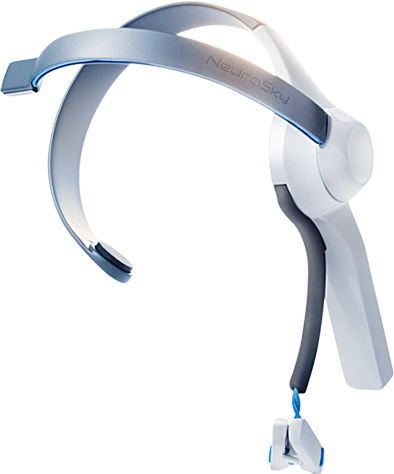
Their sensors are already built into products from Mattel in the MindFlex 3D puzzle game, the Uncle Milton Star Wars force trainer game, the PLX XWave add-on for iPxx platforms that use other apps for brain educations, exercise, and entertainment. Toshiba’s MindTune headsets extract alpha, beta, delta, theta, and gamma waveforms and amplify them for display on a screen to provide a A-V feedback loop.
In conjunction with the US Archery team, their research has shown the mental processes in effect at the time of a shot. The archer has to get to a balance of relaxation and intensity to be accurate. Using these data, the functions are now in the BrainAthlete Golf Trainer, a coaching tool to help golfers place themselves in the mental state where they are the most accurate with their swing.
When applied to electronic games, the bio-feedback can greatly enhance playability by adjusting the game intensity to brain activity. If you are overstressed, a game could automatically dial back the game intensity or enhance your capabilities. In multi-player games, the opponents could be “normalized” to allow less-skilled players to keep up with high-skill players. Some research has shown that this handicapping actually improves enjoyment and immersion for all players. After all, who wants to play with a newbie or what novice wants to challenge an expert head-to-head.
Although this product gets us closer to a direct brain-computer interconnect, the ability to integrate the sensors into a game requires extensive re-architecturing of game interfaces and game logic. To be effective, the game must now take into account the player’s mental state when progressing through levels.
Other uses could be in physical sports. Currently, head injuries are a growing concern for sports athletes. A low-cost sensor enables on-field diagnosis of concussions by comparing evoked brain response to a previously captured baseline. It doesn’t stop the injuries, but does allow someone to tell if a player has a concussion and keep that player out of the rest of the game.
