


Qi Wireless Charging – CES 2012
January 6, 2011, – Livermore, CA- We talked to Camille Tang of Convienient Power which was one of the original members of the Qi Wireless Power Consortium. In a pre-CES update, she talked about the progress made in the group and the surpirsing developments in the adoption.
Qi Wireless Charging pad
The past couple of years at CES have seen intro and prototype products in the inductive/wireless charging arena from major companies such as Maxell, EverReady, and PowerMat. These were based on a retrofit power solution that required an add-on unit to your mobile device to get the power and fed tit ot the battery. One of the major advances to the program is the release of 17 models of mobile phones that incorporate the design as a standard feature using the interoperable technology. There are feature phones and smart phones under with Verizon and NTT DoCoMo by LG, HTC, Motorola, Samsung, Fujitsu NEC and others. These devices can use chargers from multiple suppliers to power the device and it eliminates the “wall wart” style transformer that comes with each product and are filling up recycling centers and landfills.
TI Qi Wireless Power Charger Dev Kit
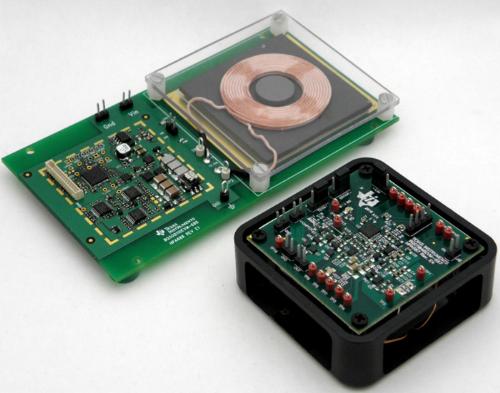
The wireless charging system is very heavily adopted in Japan. NTT DoCoMo predicts that by 2015, all the Japanese mobile devices will use this power technology. One of the things that makes this possible, is the infrastructure that is being rapidly adopted. In addition to the charging technology and sync technology, the availability of charging stations outside the home and your workplace is a key to adoption. There are now over 150 facilities with wireless charging stations at airports, some convention centers, major hotels and now coffee shops in Japan. These allow patrons to place thier device on the power pad and recharge thier cellular products.
These initial uses are all based on the approx 4 industrial design and function architectures that were in place in 2009. The Qi WPC now supports over 12 basic architectures and these provide over 20 options for implementation from standalone to multi-function platforms for charging. These new options have opened the OEM application space from celluar handsets to Home/Auto/Medical and industrial wireless connectively based devices as the market.
The current products being shown are all supporting the sub 5W power space as defined in the current version of the spec. There is a new medium power working group that is addressing 10W and 30W applications. Additionally, there is a high power changing specification that will support wireless power up to the 120W range in the near future that is being developed. Initial designs are still working with the beta testers programing level of 2.5W which is sufficient for most phones.
The high current versions support a shorter charging cycle, and they are collecting data as to ho o increase the relative distance between the object and the charger. To date the focus is on the positioning and coupling sync of device/charger. The rise in adoption from the infrastructure side has now accelerated the addressing of the cost, charging time, safety and recharging cycles/characteristics of the units.
At CES these new form factors – direct charging tables, multiple device chargers etc, will be displayed at ehe Digital Experience event. Additionally, the medium power working group will display tablet and large format MIDs utilizing the Qi technology.
Just as the USB-IF is helping to address the wall transformer glut and eliminate connection wires, so is the WPC.
