


Casio’s New Digital Stage Piano – Privia Pro PX-5S
January 2013 – At the NAMM 2013 event in Anaheim, Casio introduced thier new flagship digital stage piano the Privia Pro PX-5S. The portable device (a mere 24 lbs) is a full 88 weighted key stage piano, and also a fully programmable keyboard & synthesizer as well as a 4 zone master control unit for DAWs and other software tools. Using the Tri-Sensor Scaled Hammer Action keys as the basis, the unit features 340 presets with 220 of them user definable.
Casio Privia PX-5S Digital Stage Piano
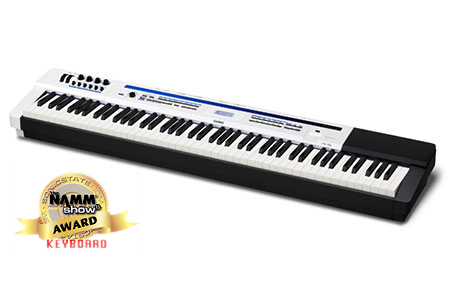
The core of the new PX-5S Stage Piano is Casio’s “AiR” sound source. This source is a high realism and detail sampling/modeling sytem for the expression of grand piano sounds. The PX-5S uses an expanded version of the AiR sound source with increased fidelity and control over other instrument tones & effects using an industry leading 256 notes of polyphony.
The piano function are augmented by the controllers functions which include 4 knobs, 6 sliders, Pitch & Modwheel, 2 Pedal Inputs and 4 simultaneous programmable controls. The programmable keyboard and synthesizer functions include a Phrase sequencer with 8 tracks and up to 1000 phrases; storage with USB/ File & Audio recording; System Effects with Reverb, Chorus, Delay, String & Damper Resonance; Insert Effects with 4 simultaneous / Equalizer, Compressor, Limiter, Enhancer, Early Reflection, Phaser, Chorus, Flanger, Tremolo, Auto Pan, Rotary, Drive Rotary, LFO Wah, Auto Wah, Distortion (w/ Amp Simulator), Pitch Shifter, Multi Chorus, Ring Mod, Delay, Piano effect; Master Effects with 4 Band EQ & Compressor and a MIDI interface with independent USB & MIDI I/O.
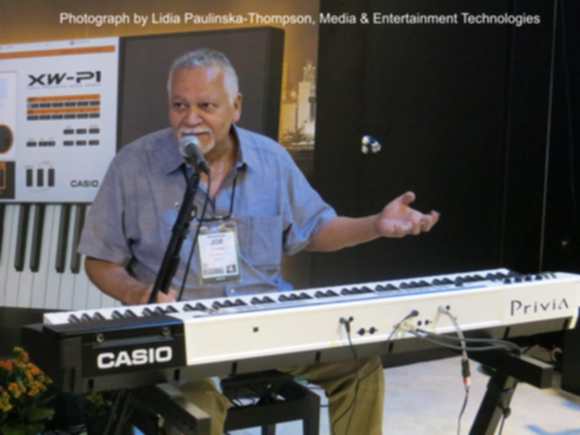
In addition to Privia’s grand piano sounds, the unit has an arsenal of newly developed sounds including a classic electric piano, harpsichord and clav sounds. Some of these tones are complete with fully released samples, amplifier and speaker simulations for an incredibly authentic experience. At the press conference, hosted by Casio VP Stephen Schmidt and the Privia PX-5S was demonstrated by jazz legend Joe Sample.
