


Invensense Releases New Sensor, SDK
January 7, 2013, We talked with Invensense about their newest 9-axis motion tracking device and a new SDK and reference design. The company is looking to tap into the growing market for sensors, possibly hitting over $2.5 B in consumer devices and an additional $2 B in industrial and automotive by 2015.
In the mobile space, one of the challenges is to enable mobile sensing on minimal power. The latest mobile tracking device, the MPU-9250 is one of the lowest power 9-axis devices on the market. The company is focusing on the smart phone market in the short-term, but is seeing an emerging market for industrial-grade devices.
The 9250 includes a 3-axis accelerometer, 3-axis gyroscope, and 3-axis magnetometer plus an on-board digital motion processor that allows for factory testing and calibration. The accelerometer has a 6.4 uA low-power mode. The compass has 16 –bit resolution, and full-scale +/- 4800 uT. The product is compatible with the existing software platform, but the integrated sensor fusion in the product may make customization and sensor separation a challenge. Full production release is slated for Q2 of ’13, samples are available now.
New applications enabled by the new component include wearable sensors and fitness watches. To address this market, they released a contextual awareness SDK and reference design for watchband sensor platforms. The watchband can track and recognize multiple activities including running, swimming, biking, tennis, and walking.
Invensense SDK Position and sensor development system
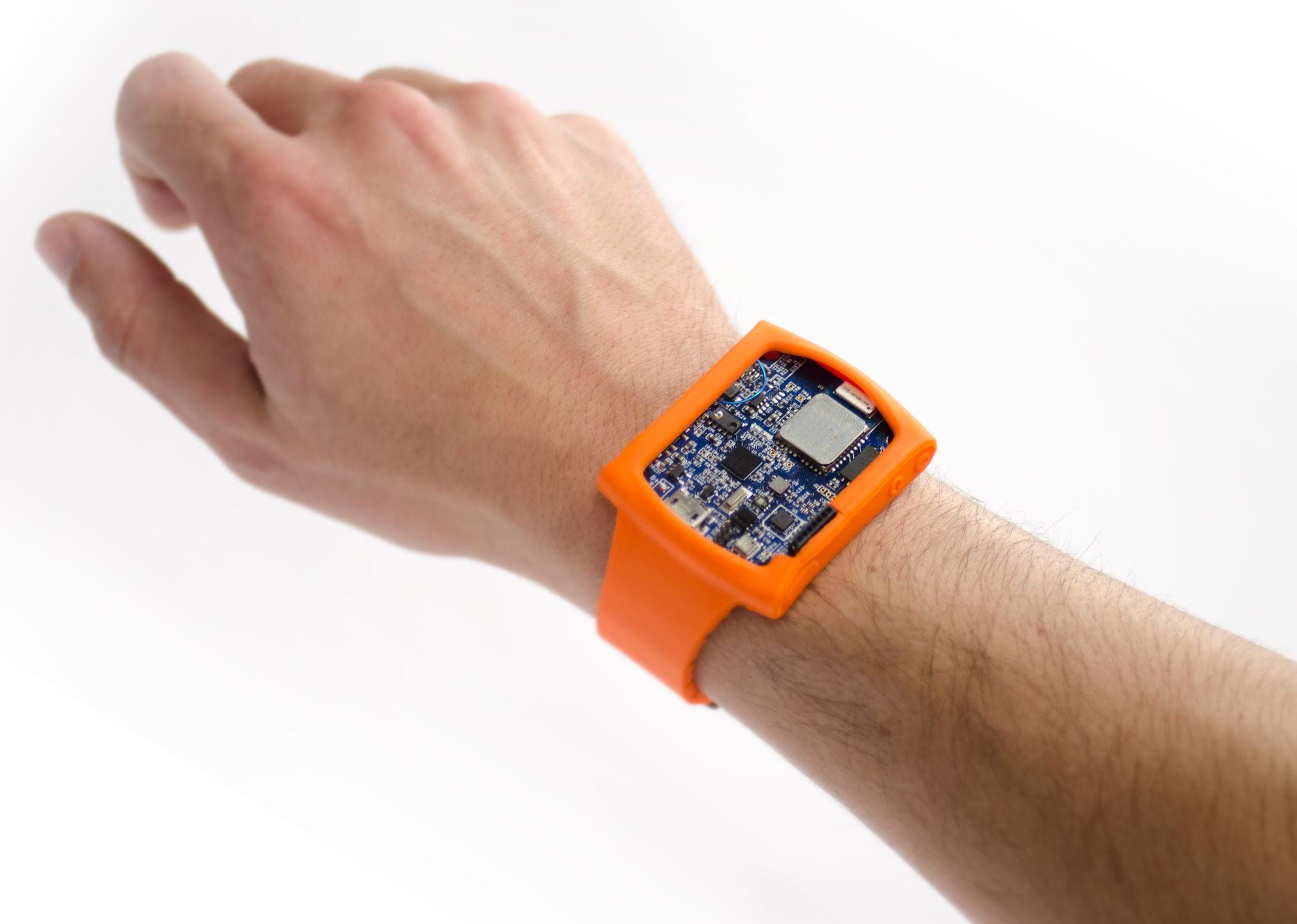
The SDK can also sense posture, sleep monitoring, and local environment. By adding other sensors, the watchband and associated algorithms can measure temperature, humidity, UV and visible light, proximity, and pressure. The embedded motion processor provides contextual information, and can track calorie expenditure. The combination of sensors and software can perform equivalent functions as a GPS tracker, reducing a fitness recorder volume by over half. The absence of a radio implies a longer battery life for a watchband-type of product. The SDK includes a library of functions, USB port, and a Bluetooth low energy interface.
